A young man clothed in body armor entered Club Q in Colorado carrying an assault rifle and started shooting as a drag queen danced. In maybe two minutes, he killed five people and wounded, according to some accounts, 18. Then a patron risked his life, tackled the shooter, held him immobile till police arrived.
Five people killed, a few more critically injured. This time the minority group targeted—“the enemy”—was the LGBTQ community.
Hatred, guns, “permission.”
In that sense, yes, America is the land of the free: free to imagine an enemy . . . free to project your own self-hatred outward, onto a specifically defined group of people and sculpt them into the enemy, perhaps with the help of others, especially via social media. We are also free, for the most part, to purchase guns, including assault rifles, and lots of ammo, and plan an attack—at a church, a school, a grocery store, a nightclub, whatever.
Colorado Rep. Lauren Boebert, for instance, who tweeted remorse about the Club Q shooting and said the victims and their families “are in my thoughts and prayers,” had, until then, been a notorious tweeter of anti-LGBTQ blather, making the fact-free case that they were “sick, demented” people bent on “grooming” innocent children to become gay—kind of in the same way, it seems, that refugees, according to Donald Trump, not only take our jobs but are often rapists and murderers. Create an enemy, get a following! (And guns are just for self-defense.)
We can’t stop tolerating hate until we realign ourselves with what it means to be alive, for which South Africans have a term: ubuntu: “I am because you are.”
And now we need a national stopping point, as we let this truth transform us. This will never be a perfect world. This will never be a world without conflict. But let’s pause in this moment, calm ourselves, set down our hatred and look each other in the eyes. I am because you are.
Robert Koehler is the author of ‘Courage Grows Strong at the Wound.’
Another excellent article by intrepid investigative reporter Peter Bryne, with deeply disturbing photos that Jocelyn Knight took which accompany the text!
Interestingly, on the same day I picked up your periodical, an email arrived from the campaign account of Congressmember Jared Huffman, wanting to “share reflections and experiences” from the climate catastrophe conference (COP27) he’d just gotten back from attending in Egypt. Unfortunately, that conference apparently neglected to include within its teachings a phrase initially used around the time of the first Earth Day in 1970: “Think globally, act locally.”
There is no denying our continued meaningful habitation upon this planet requires that eight billion people everywhere exhibit a level of care and stewardship heretofore lacking from too many. However, one does not need to fly over 7,000 miles from California to find obvious opportunities to change course regarding the plight of our planet.
Point Reyes National Seashore, wholly within Huffman’s own congressional district, has significant climate altering pollution problems which have festered for decades. These could easily be solved with simple solutions; promptly get the non-Indigenous cattle and their ranchers out of the place “We the People” already paid for long ago, then fully restore the habitat plus Indigenous civilizations’ sacred sites. Happy Thanksgiving.
Tim Smith
Former Mayor of Rohnert Park
Sunlight
Holy cow?!? Excellent reporting, Peter Byrne and Bohemian! Thank you, and keep up the good work. We can only hope this situation improves sooner than later because of your efforts to bring it out in the open!
Fort Ross-Seaview is a small wine growing region that consists primarily of steep coastal ridge vineyards set between 900 and 1,800 feet above sea level.
The region was approved as an American Viticulture Area (AVA) in early 2012 and is defined by both its proximity to the ocean and its high elevation.
Vineyards here are rugged and difficult to farm—with most being planted on steep hillsides that can only be harvested by hand and producing low yields per acre.
Among the founders of the Fort Ross-Seaview AVA are Fort Ross Vineyard owners Linda and Lester Schwartz. The couple also founded the Fort Ross-Seaview Winegrowers Association and are active in promoting the region and its vineyards.
Other producers that make wines from the Fort Ross-Seaview AVA include Failla, Flowers, Martinelli and Wayfarer. Fort Ross Vineyards is the only brand that also has a winery and tasting room located in the region.
Winery and Vineyards
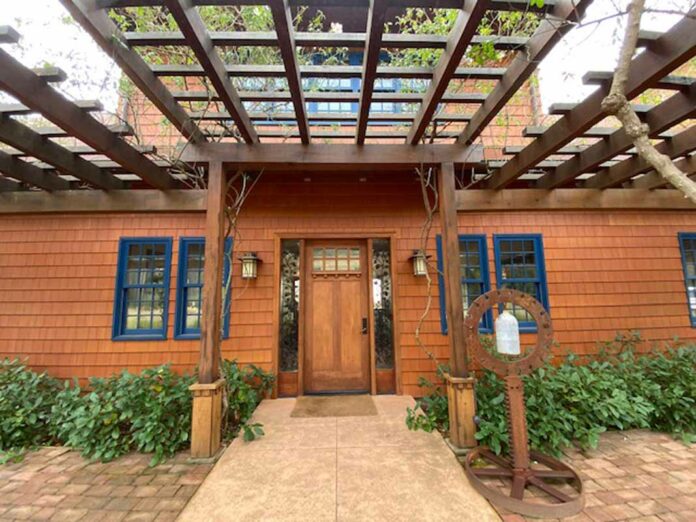
Situated on a 100-acre property purchased by the Schwartzes in the late ’80s, Fort Ross Vineyards sits atop a hill at about 1,600 feet elevation. The winery farms around 50 acres of vineyards, growing a mixture of pinot noir, chardonnay, and pinotage (an homage to Lester and Linda Schwartz’s South African roots).
While located in a coastal region, Fort Ross Vineyards’ estate vineyards don’t get temperatures as cool as might be expected because they sit in a protected site, with elevations that are so high that the vineyards sit primarily above the fogline. This means that while the vines are affected by the cooler air that comes off of the Pacific and the high elevation rugged terrain, the fog burns off much earlier in the day than it does in lower lying vineyards. This allows the vineyards to get more hours of direct sunlight, making the wines from this AVA riper than those from some other coastal AVAs.
Winemaking Style
The wines at Fort Ross are fresh, balanced, concentrated and elegant. Winemaker Jeff Pisoni took over winemaking in 2009, bringing with him his decade of experience of working with pinot noir from coastal and cooler climate sites. His experience, merged with Linda and Lester Schwartz’s desire for the wines to showcase the uniqueness of the terroir and to produce wines that are balanced and elegant, has led to the winery making some of the best wines in its history over the past decade.
Tastings Menus
All tastings, available by appointment only, include a flight of four wines served with four courses of paired bites prepared by the winery’s in-house chef. The menu, which changes regularly, incorporates seasonal ingredients and flavor components that complement the wines. Vegan, vegetarian and gluten free options are available (and are just as delicious).
Highlights from a recent tasting menu included the following: “Roasted Wild Mushroom, White Corn Grits, Black Tea Infused Honey Pine Nuts, Laura Chenel Goat Cheese,” as well as a “Chicory & Coffee Crusted New York Strip Steak, Crispy Red Potatoes, Wild Arugula Pinotage Gastrique.”
Having done the food and wine pairing recently myself (as a gluten free diner), I can say that the experience is fantastic.
If the sky is clear, visitors can enjoy views of the ocean. After a tasting, they can take a walk around the property’s gardens, a good excuse to spend a little bit more time in this peaceful, beautiful place.
Fort Ross Vineyards offers appointment-only tasting experiences Friday through Tuesday, 10am-3pm. The property is only open to those with an appointment. To book, visit fortrossvineyard.com/visit.
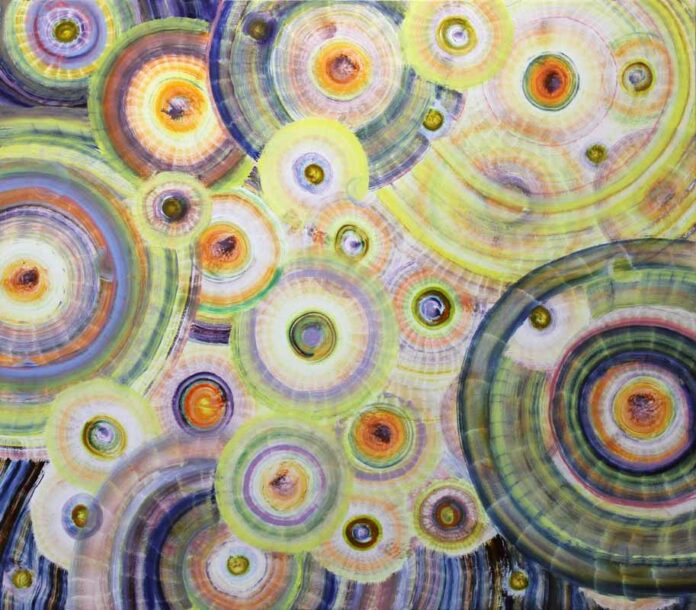
San Anselmo gallery Garvey|Simon presents a three-woman exhibition, Marking Impressions, featuring works by artists Melanie Parke, Claire McConaughy and Danielle Riede through Dec. 30. Paintings in the show are large in scale and embody each of the artists’ skill and creative vision “birthing exuberant environments rife with playful gesture and color,” according to a recent release. Claire McConaughy’s boldly expressive and vibrant landscape paintings evoke poetic moments connected to the present and past; Danielle Riede’s dreamy abstractions begin with a single intuitive gesture off of the canvas and then a recording of that same movement in paint; and Melanie Parke’s lush paintings combine landscape, interior and still-life elements. Garvey|Simon is located at 538 San Anselmo Ave., San Anselmo. For more information, visit garveysimon.com.
Napa
Merry Market
Oxbow Public Market ushers in the holidays with festive live music throughout the season, beginning with members of the Napa High Choir at 6 pm, Dec. 6. To underscore the holiday spirit, there will also be a 12-foot Christmas tree, a six-foot menorah, as well as two “Letters to Santa” mailboxes where children of all ages can drop off their letters to Santa. Additionally, the market has partnered with Community Action NapaValley, NEWS and Napa Wildlife Rescue on a “Holiday Giving Tree,” where market customers can pick a tag off the tree and make a donation directly to the non-profit. Oxbow Public Market is located at 610 and 644 First Street in downtown Napa. For more information, visit oxbowpublicmarket.com.
Petaluma
Members Only at PAC
The 2022 Members Exhibition at the Petaluma Arts Center (PAC) kicked off pre-Thanksgiving with a well-attended reception for the annual showing, which has been a tradition of the Petaluma Arts Center since 2008. The show realizes PAC’s central mission: building community through the arts. This year’s exhibition, curated by Jennifer Bethke and Vicky Kumpfer, features a wide variety of media—from painting to sculpture, ceramics and beyond—showcasing a diverse range of stylistic approaches and subjects that highlight the talents of the city’s many local artists and makers. Petaluma Arts Center, 230 Lakeville St. 707-762-5600. Petalumaartscenter.org.
Santa Rosa
Drag Queen Christmas
For the eighth consecutive year, Murray & Peter present A Drag Queen Christmas. Hosted by RuPaul’s Drag Race alumna Nina West, who recently cameoed as director John Waters’ leading lady Divine in Weird: The Al Yankovic Story, the show features a calvary of talented queens, performing live music, dance and comedy numbers, dressed to the nines in glitzy costumes. A VIP “meet and greet” precedes the show, at which fans can meet the queens, take pics and ask for autographs, and obtain tour swag, including an official tour poster and laminate with lanyard. The performance begins at 8 pm, Dec. 2 at the Ruth Finley Person Theater, Luther Burbank Center for the Arts, 50 Mark West Springs Rd., Santa Rosa. Tickets are $41, up to $156 for the meet and greet. More info at lutherburbankcenter.org/event/drag-queen-christmas.
ARIES (March 21-April 19): Journalist Hadley Freeman interviewed Aries actor William Shatner when he was 90. She was surprised to find that the man who played Star Trek’s Captain Kirk looked 30 years younger than his actual age. “How do you account for your robustness?” she asked him. “I ride a lot of horses, and I’m into the bewilderment of the world,” said Shatner. “I open my heart and head into the curiosity of how things work.” I suggest you adopt Shatner’s approach in the coming weeks, Aries. Be intoxicated with the emotional richness of mysteries and perplexities. Feel the joy of how unknowable and unpredictable everything is. Bask in the blessings of the beautiful and bountiful questions that life sends your way.
TAURUS (April 20-May 20): Of all the objects on Earth, which is most likely to be carelessly cast away and turned into litter? Cigarette butts, of course. That’s why an Indian entrepreneur named Naman Gupta is such a revolutionary. Thus far, he has recycled and transformed over 300 million butts into mosquito repellent, toys, keyrings and compost, which he and his company have sold for over $1 million. I predict that in the coming weeks, you will have a comparable genius for converting debris and scraps into useful, valuable stuff. You will be skilled at recycling dross. Meditate on how you might accomplish this metaphorically and psychologically.
GEMINI (May 21-June 20): Tips on how to be the best Gemini you can be in the coming weeks: 1. Think laterally or in spirals rather than straight lines. 2. Gleefully solve problems in your daydreams. 3. Try not to hurt anyone accidentally. Maybe go overboard in being sensitive and kind. 4. Cultivate even more variety than usual in the influences with which you surround yourself. 5. Speak the diplomatic truth to people who truly need to hear it. 6. Make creative use of your mostly hidden side. 7. Never let people figure you out completely.
CANCER (June 21-July 22): In my dream, I gathered with my five favorite astrologers to ruminate on your immediate future. After much discussion, we decided the following advice would be helpful for you in December. 1. Make the most useful and inspirational errors you’ve dared in a long time. 2. Try experiments that teach you interesting lessons, even if they aren’t completely successful. 3. Identify and honor the blessings in every mess.
LEO (July 23-Aug. 22): “All possible feelings do not yet exist,” writes Leo novelist Nicole Krauss in her book, The History of Love. “There are still those that lie beyond our capacity and our imagination. From time to time, when a piece of music no one has ever written, or something else impossible to predict, fathom or yet describe takes place, a new feeling enters the world. And then, for the millionth time in the history of feeling, the heart surges and absorbs the impact.” I suspect that some of these novel moods will soon be welling up in you, Leo. I’m confident your heart will absorb the influx with intelligence and fascination.
VIRGO (Aug. 23-Sept. 22): Virgo author Jeanette Winterson writes, “I have always tried to make a home for myself, but I have not felt at home in myself. I have worked hard at being the hero of my own life, but every time I checked the register of displaced persons, I was still on it. I didn’t know how to belong. Longing? Yes. Belonging? No.” Let’s unpack Winterson’s complex testimony as it relates to you right now. I think you are closer than ever before to feeling at home in yourself—maybe not perfectly so, but more than in the past. I also suspect you have a greater-than-usual capacity for belonging. That’s why I invite you to be clear about what or whom you want to belong to and what your belonging will feel like. One more thing: You now have extraordinary power to learn more about what it means to be the hero of your own life.
LIBRA (Sept. 23-Oct. 22): It’s tempting for you to entertain balanced views about every subject. You might prefer to never come to definitive conclusions about anything, because it’s so much fun basking in the pretty glow of prismatic ambiguity. You LOVE there being five sides to every story. I’m not here to scold you about this predilection. As a person with three Libran planets in my chart, I understand the appeal of considering all options. But I will advise you to take a brief break from this tendency. If you avoid making decisions in the coming weeks, they will be made for you by others. I don’t recommend that. Be proactive.
SCORPIO (Oct. 23-Nov. 21): Scorpio poet David Whyte makes the surprising statement that “anger is the deepest form of compassion.” What does he mean? As long as it doesn’t result in violence, he says, “anger is the purest form of care. The internal living flame of anger always illuminates what we belong to, what we wish to protect, and what we are willing to hazard ourselves for.” Invoking Whyte’s definition, I will urge you to savor your anger in the coming days. I will invite you to honor and celebrate your anger, and use it to guide your constructive efforts to fix some problem or ease some hurt. (Read more: tinyurl.com/AngerCompassion.)
SAGITTARIUS (Nov. 22-Dec. 21): Sagittarian comedian Margaret Cho dealt with floods of ignorant criticism while growing up. She testifies, “Being called ugly and fat and disgusting from the time I could barely understand what the words meant has scarred me so deep inside that I have learned to hunt, stalk, claim, own and defend my own loveliness.” You may not have ever experienced such extreme forms of disapproval, Sagittarius, but—like all of us—you have on some occasions been berated or undervalued simply for being who you are. The good news is that the coming months will be a favorable time to do what Cho has done: hunt, stalk, claim, own and defend your own loveliness. It’s time to intensify your efforts in this noble project.
CAPRICORN (Dec. 22-Jan. 19): The bad news: In 1998, Shon Hopwood was sentenced to 12 years in prison for committing bank robberies. The good news: While incarcerated, he studied law and helped a number of his fellow prisoners win their legal cases—including one heard by the U.S. Supreme Court. After his release, he became a full-fledged lawyer, and is now a professor of law at Georgetown University. Your current trouble isn’t anywhere as severe as Hopwood’s was, Capricorn, but I expect your current kerfuffle could motivate you to accomplish a very fine redemption.
AQUARIUS (Jan. 20-Feb. 18): “I stopped going to therapy because I knew my therapist was right, and I wanted to keep being wrong,” writes poet Clementine von Radics. “I wanted to keep my bad habits like charms on a bracelet. I did not want to be brave.” Dear Aquarius, I hope you will do the opposite of her in the coming weeks. You are, I suspect, very near to a major healing. You’re on the verge of at least partially fixing a problem that has plagued you for a while. So please keep calling on whatever help you’ve been receiving. Maybe ask for even more support and inspiration from the influences that have been contributing to your slow, steady progress.
PISCES (Feb. 19-March 20): As you have roused your personal power to defeat your fears in the past, what methods and approaches have worked best for you? Are there brave people who have inspired you? Are there stories and symbols that have taught you useful tricks? I urge you to survey all you have learned about the art of summoning extra courage. In the coming weeks, you will be glad you have this information on which to draw. I don’t mean to imply that your challenges will be scarier or more daunting than usual. My point is that you will have unprecedented opportunities to create vigorous new trends in your life if you are as bold and audacious as you can be.
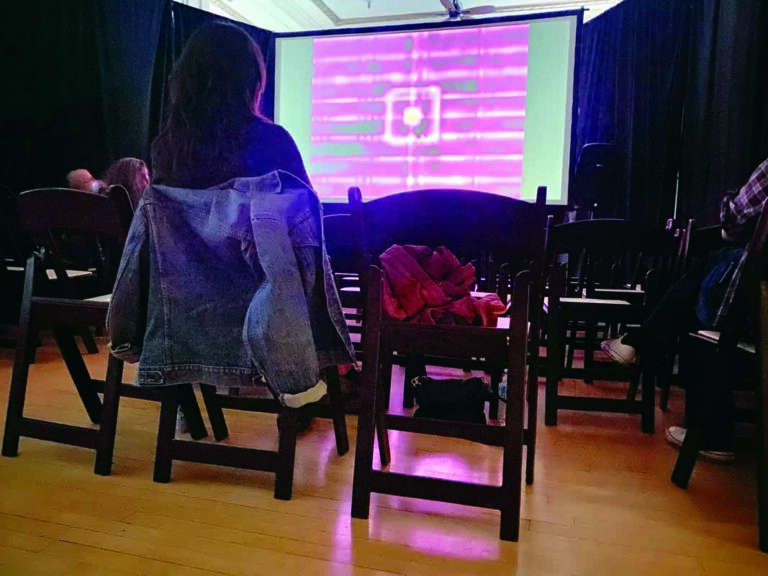
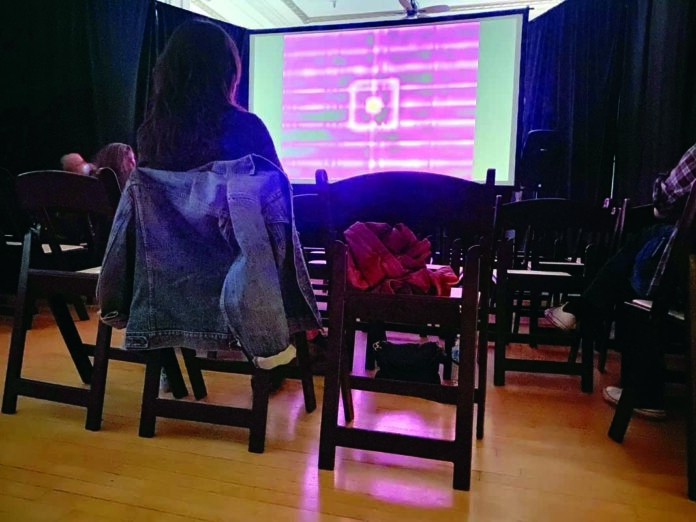
On a mid-November weekend, tucked inside the Grand Ballroom of the historic Hotel Petaluma, a few dozen people gathered at an intimate pop-up cinema to watch a selection of “unique, antique and experimental films.”
This was the eighth annual report—as the event is called—of the Camera Obscura Film Society, programmed by co-directors Jonathan Marlow and Amanda Salazar. It marked a return to Petaluma after a few years online and in San Francisco.
Just outside the ballroom, it seemed that most people at the hotel didn’t know the event was going on. Aside from a few social media posts and an enigmatic postcard on a table in the hotel lobby, there wasn’t much advertising. Yet, the society has collected a small crowd of dedicated members since it convened in 2015, and the feeling inside was one of warmth and excitement.
Between its near-secrecy and its curation of obscure works, it would be easy for Camera Obscura to come across as pretentious and exclusive. Instead, it feels like a gift. With decades of experience programming for film festivals and arthouse streaming sites, Salazar and Marlow are professional film lovers inviting viewers to watch a selection of treasures they’ve discovered. Their curation feels at once accessible and mysterious. I watched four of this year’s eight programs and came away eager for more. I loved a few of the films I saw, and enjoyed being there even for the films I didn’t love.
Camera Obscura Film Society is older than its current directors. Marlow and Salazar’s project is conceived of as a re-convening of a society by the same name, founded by Bay Area filmmakers Lawrence Jordan and Bruce Conner, which presented eclectic programs between 1957-1962. Jordan, who now lives in Petaluma, gave Marlow and Salazar his blessing, and his films are featured in each new report.
It was easy for Marlow and Salazar to gain the trust and interest of filmmakers and distributors when they endeavored to revive Camera Obscura, given the deep relationships they had built through their careers. Marlow co-founded and, until 2016, worked as chief content officer of the arthouse streaming service Fandor. Salazar worked with Marlow as Fandor’s director of acquisition.
“Back when Fandor was at the peak of its reputation and production, it was a really wonderful place to work,” says Salazar. “Jonathan carefully built relationships of mutual respect with filmmakers in order to bring on their work….So when we told artists we were starting a small pop-up cinema and wanted to do a live screening of their work, a lot of filmmakers told us, ‘Anything you want. You saw something in my work that no one else saw.’”
By design, Marlow and Salazar don’t reveal much about their lineup in advance. Curious minds can seek out Camera Obscura’s social media page, which announces the film titles in each program a few days before the event, without synopses.
“We’re encouraging people to just have an experience, asking them to trust us—which is a hard thing to ask,” Salazar says, noting that it’s counter to how most people see movies.
Most attendees buy-in to the mystery, as evidenced by a Kickstarter campaign that easily met its goal before the programs were announced. The $7000 budget enables them to rent the venue, purchase equipment to show the works, pay screening fees to artists and provide travel accommodations to visiting filmmakers.
“The fact that a number of people who were there with us have already signed up to participate in the next one is what obliges us to keep doing this,” says Marlow.
Both Salazar and Marlow describe a frequent phenomenon of people showing up for one screening because they know a director, then staying for other programs and returning the following year.
“The idea is not that you’re buying admission to a show. The idea is that all participants are members, even if it’s just for two hours,” Marlow says.
Jointly programmed by Marlow and Salazar, each of the eight programs in this year’s lineup pair shorter works with longer works.
“We give the shorts equal platform with features so that it’s evident that they’re on the same playing field [as features], and the works can be in conversation with each other,” says Salazar.
“A key component of Camera Obscura is to play things that are older with things that are newer to see how they resonate with each other,” adds Marlow.
A still from ‘Soft Fiction’, Chick Strand’s 1979 feature documentary. Courtesy of Camera Obscura Film Society
One program paired Anna Kipervaser’s 2021 short, In Ocula Oculorum, with Chick Strand’s 1979 feature documentary, Soft Fiction. In her introduction to the program, Salazar said that Soft Fiction, which was recently restored, had been on her mind after Roe v. Wade was overturned. She talked about the way bodies are featured in each film, encouraging the audience to talk afterwards about the relationship found between the films.
The experimental short is visceral, presenting flickering images of human bodies—organ systems and brain scans—set to a dissonant, grating soundtrack. In Kipervaser’s words, “In Ocula Oculorum interrogates the unknown and the internal, in both subject matter and experience” and deals with “the contemporary state of perpetual doom.”
In contrast to this harsh viewing, Strand’s black and white film is softer visually, with all of its harshness coming from the content of the stories narrated within it. Filmed between 1976-79 around Los Angeles, five women share candidly about erotic fantasy, sexuality and trauma in oral histories Strand described as “exorcisms of an experience.”
“It’s crucial for us to seek out underrepresented voices,” Marlow says. “It’s always been key to have a large number of women filmmakers and queer filmmakers in the program. We want audiences to see that work because they’re not getting opportunities to see it often enough.”
After this year’s screening of short film, The Shadow Line, by Healdsburg-based filmmaker Toney Merritt, an audience member remarked that they weren’t aware that there are Black filmmakers making experimental work in the Bay Area. The comment opened up a conversation about other local Black experimental filmmakers, but also about how infrequently their films are screened.
A still image from ‘We Were There To Be There’. Courtesy of Camera Obscura Film Society
The North Bay itself featured prominently in two films screened this year: in Lawrence Jordan’s rarely-seen 1976 film, The Apparition, filmed on a homestead in Laytonville, and in Mike Plante’s 2021 short film, We Were There To Be There, about an unlikely free punk concert The Cramps and The Mutants played for patients at Napa State Mental Hospital in 1978.
When Plante stood up to speak about his film, I was pleased to recognize that he’d been in the audience watching other programs.
“My hope for the future is that one day it will be just an audience of people that come and stay the whole weekend,” says Salazar, whose favorite moments are watching audience members meet one another and then spend the intervals between programs talking about the work, having just experienced the films together.
In recent years, it has become increasingly common to hear public officials and event hosts naming the Native tribes on whose ancestral lands an event is taking place.
These “land acknowledgements” are an important signal of raising awareness about the physical, social and economic genocide that continues to impact Native Americans.
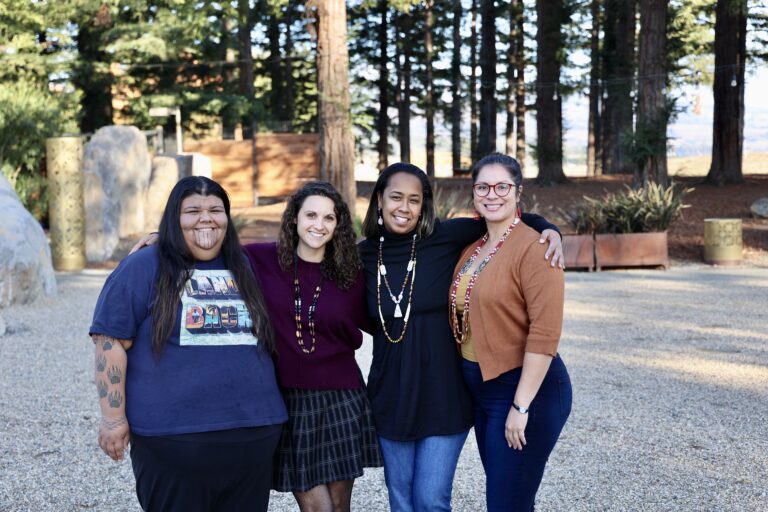
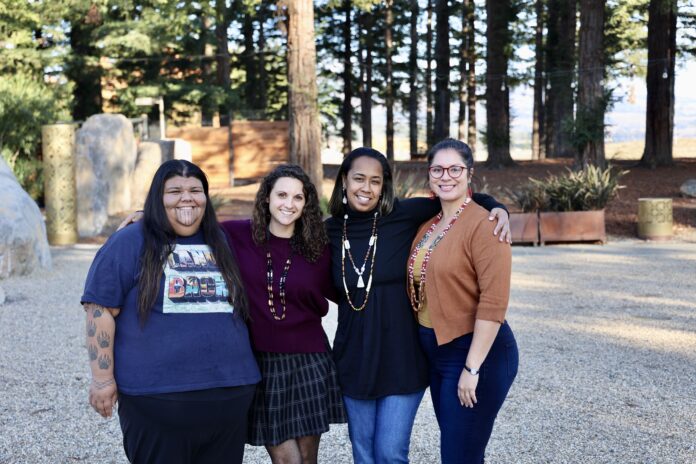
Yet some, including Taylor Pennewell, executive director of the Rohnert Park-based nonprofit Redbud Resource Group, are convinced it’s time to do more.
Founded in June2020, Redbud is committed to building bridges between Native and non-Native communities through public education programming and institutional training. The group aims to bring the history of Native people back to the forefront of California education and land stewardship. It also supports calls to return the ownership of land to Native people, generally referred to as #LandBack.
Groups giving land acknowledgement are “basically admitting that they are occupying, that they are in the role of colonizer actively. It’s not something in the past; it’s something that’s present, ongoing,” Pennewell said in an interview at the nonprofit’s office.
“Saying that you recognize someone’s existence is really, really fundamental to living a healthy life and being in a relationship with people [who are] in your community,” Pennewell said. However, “many Americans don’t think Native American people exist. That we don’t exist anymore. And this is tied to all these really big public health issues that Native communities face, [the] effects of being physically erased.”
These harms may be compounded by the generational trauma of being erased, but they are not of a past time. They are present, verifiable and community-wide. For example, Native people have a life expectancy 5.5 years lower than the national average.
“The problem [with land acknowledgements] is that they don’t really do much to address the root of inequities that Native people face [in the present time],” Pennewell said. “Which is what Redbud is all about. Teaching people how to go beyond [acknowledgements] with really concrete action.”
A first step is increasing public knowledge about the killing of America’s Native people.
Many readers may associate the European conquest of North America with images of Spanish galleons full of gold loaded by Native slaves under the lash of whips, or colonizers using smallpox-infected blankets to open up land for western-bound wagon trains. However, discussions of California’s history often omit how the genocide continued well after the state’s formation in 1850.
As a member of Gov. Gavin Newsom’s Council for Holocaust and Genocide Education, Pennewell is working to ensure that the mass killing of Native people between 1846 and 1871, known as the California Genocide, is included in public K-12 curricula. Pennewell hopes that the council’s work will become a model for national education. (To learn more about this subject, Pennewell recommends reading An American Genocide by Benjamin Madley.)
“When you really look into the tactics of the genocide, [settlers] were just extremely ruthless,” said Pennewell. “[They showed] a really unprecedented blood thirst.”
Rose Hammock is a tribal member of the Round Valley Indian Tribes, among the groups that were rounded up and driven—using cattle wrangling techniques—to reservations and rancherias designated by settler authorities, including the state of California.
“It’s a miracle for Taylor and I to be here to do this work because we come directly from people who survived the genocide,” she said. Pennewell and Hammock say that there are signs that the genocide is ongoing.
One example is Texas’ legal challenge of the Indian Child Welfare Act of 1978. If the Supreme Court strikes down the law, it would “make it easier to forcibly remove Native children from their families with or without consent [of relatives],” according to Pennewell. This would deal a significant blow to tribal sovereignty and represent a continuation of the genocide, the Redbud leader argues.
In addition to improved education, Redbud supports the Land Back movement. As the name suggests, this campaign seeks to return sovereignty of land and resources to the Native communities that stewarded them before the arrival of white settlers.
“Being able to receive a parcel of land, whether it’s really big or small, just that act of being able to have land back [is important in itself]. It gives us access to resources,” Hammock, Redbud’s manager of community outreach, said.
The campaign has precedent in Northern California. In 1860, the sacred Wiyot village on Tuluwat Island, located in Humboldt Bay, was the scene of a remorseless massacre of Native women, children and elderly by local settlers who claimed to have “bought” the land, without the tribe’s consent or knowledge. One hundred and forty-four years later, the city of Eureka returned 67 acres of the island to the Wiyots of Humboldt County. In 2019, the remaining 202 acres of the island were transferred to the tribe.
The erasure of Native culture affects all. As drought-stricken California continues to burn year after year, the importance of proper stewardship is more evident than ever. The very resource management system engaged in global ecocide cannot be expected to find the key to safely managing the environment. Land management and public safety agencies have a chance to include the Native knowledge of local ecosystems that they have stewarded for millenia.
A common perception is that “the Native people would just kind of let everything grow and not touch anything,” said Hammock. In fact, Native populations “were always cutting and burning and pruning and gathering, because that’s what we know our plants need to be healthy.”
“We’re hoping that by communities having access to land, we are going to see ecosystems and the land heal,” said Hammock. “People need to heal, but our land also needs to heal. The two go together.”
At Redbud, “we’re not saying go out and do this,” said Hammock. “We’re saying, Here’s the tools to have the best relationships and … go into a conversation not just with the right language, but to go into that space in a respectful way. Or what we often say in the Native community, ‘Do it in a good way; do it the best way that you can.”
To learn more about Redbud Resource Group’s work and to access their education programs, visit www.redbudresourcegroup.org.
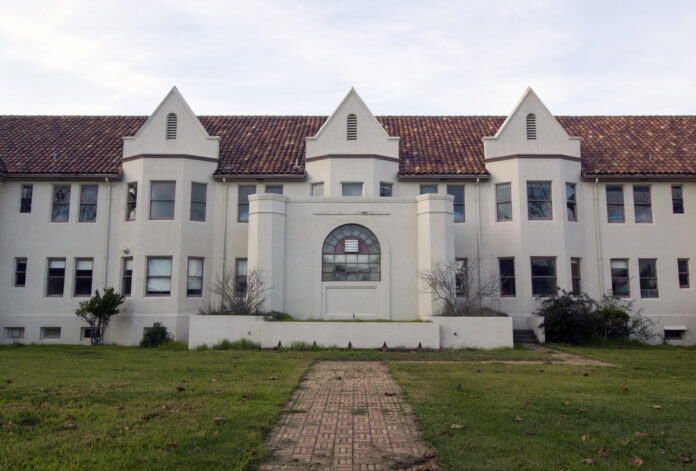
On Dec. 16, the Sonoma County Board of Supervisors is set to consider a plan to sell off 945 acres of state-owned land to a private bidder.
Known as the Sonoma Developmental Center since 1986, the Glen Ellen property was used as one of the state’s numerous mental hospitals beginning in 1883. In 2018, the center was closed and, ever since, the state has been itching to get rid of it.
As part of a state’s sell-off process, Sonoma County is required to create an environmental planning document which provides some parameters governing the future uses of the property. The county and state have accepted several rounds of public input over the past four years, but, judging from the reception to the county plan released in August, many residents feel that their requests were largely ignored.
Two public advisory groups, North Sonoma Valley Municipal Advisory Council (MAC) and the Sonoma Valley Citizens Advisory Commission, both opposed the county’s plan, arguing that it is too dense for the area.
In a letter penned in September, the North Sonoma Valley group stated that “Given the tremendous amount of input from Sonoma Valley residents and business owners concerned about the project size and its impacts, as well as this MAC’s own request and the Board of Supervisors’ direction to scale back the Specific Plan, it is surprising that the proposed Specific Plan still contains over 1,000 homes and approximately 940 jobs.”
The core conflict between residents’ hopes and the county’s plan is that the state has requested that the plan is “financially feasible and sustainable,” more directly known as “profitable for the private developer which purchases the property.”
Throughout the process, various groups pushed for alternative plans, including refurbishing existing buildings instead of building new to cut down on costs and keeping the property under public ownership.
But, none of the community outcry seems to have slowed the process much. After a series of lengthy Planning Commission meetings, where members reportedly offered dozens of edits, the document heading to the Supervisors for final approval has largely remained the same as the one unveiled in September.
Health experts in Sonoma County gave an update last week about the surge of respiratory illnesses plaguing the county and filling hospital beds.
Influenza and respiratory syncytial virus (RSV) cases are clogging hospitals across the state, especially children’s hospitals, according to the California Department of Public Health.
In Sonoma County, the problem is growing, experts said at the Nov. 15 community briefing. Add in COVID numbers that are staying about the same and residents face a trifecta of viral pathogens—some of which can infect a person at the same time.
Dr. Gary Green, infectious disease specialist for Sutter Health, provided some sobering information about what he described as an “extraordinary” amount of viruses moving through Sonoma County, with influenza making “footprints” everywhere, especially in Santa Rosa.
“Right now, out of hundreds and hundreds of flu swabs we’ve sent in, 43% are positive for influenza,” he said.
Green said the baseline for the advent of flu season is usually around 10% positive swabs. The numbers for RSV were even greater, with 60% of swabs coming back positive.
Panelists said that hospitals are near capacity but not being overwhelmed at this point, though when children are in need of hospitalization they are generally transferred to facilities out of county.
Green said that the Sutter hospital in Santa Rosa has doubled its ER space, which has helped them remain within capacity, though a tent outside is also being used. Kaiser Permanente Santa Rosa has also erected a tent for overflow, according to County Health Officer Dr. Sundari Mase.
Asked why flu season is so bad this year, Green pointed to COVID response fatigue combined with a contagious strain that previously wracked Australia’s winter this year. He also drew a comparison to the Influenza outbreak of 1918, which he said has a parallel to the COVID pandemic in that after the third year of dealing with the virus, people began taking less precautions.
“Kids are back at school. We’re all traveling for the holidays. People are mixing in their bubbles. And I think we can all expect viruses to bump [up] this year, and it’s going to be a rocky respiratory season this year—and it’s not due to one virus; it’s due to multiple,” he said.
Vaccination is the single greatest predictor of a good outcome from catching the flu, said Green. There is currently no vaccine available for RSV, but masking up and washing hands regularly are all strongly encouraged.
For those of us in Northern California, some days it seems the world is going to hell in an organic, fair trade, artisanally-woven handbasket. But that doesn’t mean it can’t be fixed.
Here’s a thought: Our accumulated, collective actions are meaningful on both a micro and macro scale. This has been the driving premise of Daily Acts, a holistic education nonprofit that helps enable “transformative actions that create connected, equitable and climate resilient communities.”
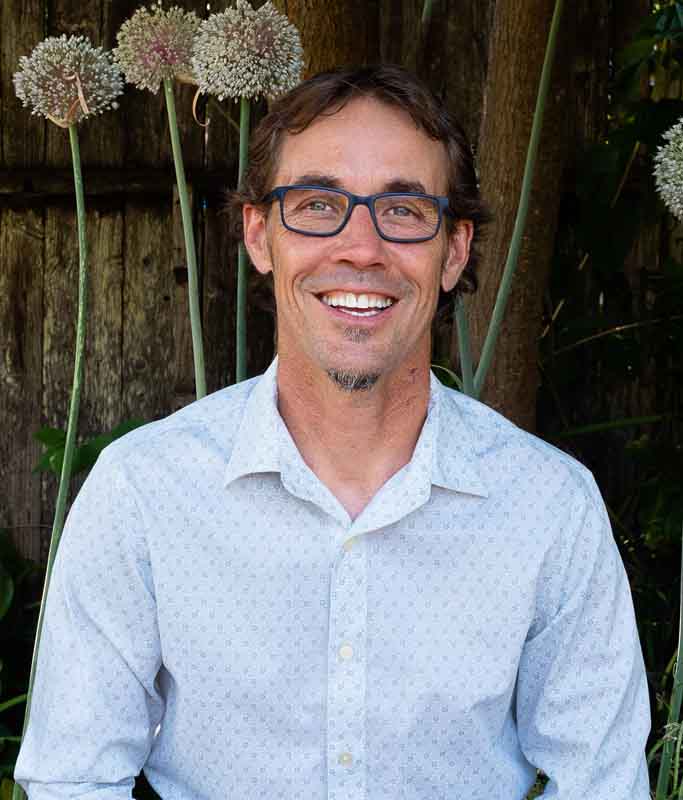
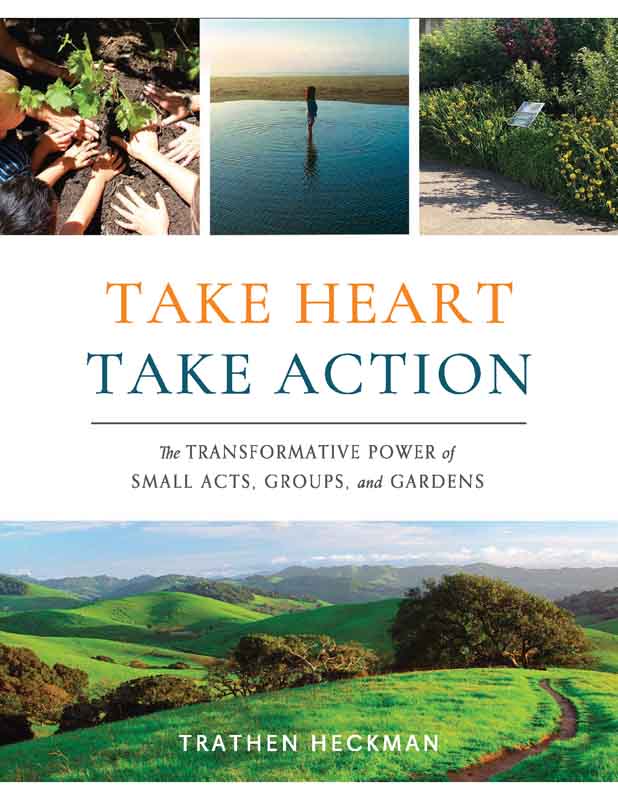
The driving force behind Daily Acts since its inception over 20 years ago is Trathen Heckman, who recently collected what he has learned shepherding moments into movements in Take Heart, Take Action: The Transformative Power of Small Acts, Groups and Gardens.
Heckman is a charismatic and passionate presence with a mind clearly firing on all cylinders. That said, he deliberately keeps his message human scale. He doesn’t present a single path so much as a process that makes any pathway both imaginable and navigable. It’s this ability that has made him a sought after speaker at such conferences as Bioneers and such a beguiling interview for jaded journos.
What follows is a transcript of a recent conversation (edited for length) that we shared in his Petaluma backyard, atop a sculpted cob bench, surrounded by a living symphony of greenery.
Trathen Heckman: Our core focus is helping people reclaim the power of their daily actions, helping people, groups and communities to unleash the power of community and address the climate crisis and sustainability inequities, all these big issues we’re facing. And you know the problem is if you look at the news, you could just get overwhelmed. There’s just bad news everywhere. And it feels like everything’s so big, it’s beyond our power to influence. And so the core message in Daily Acts and in the book is the transformative power of “small.”
Daedalus Howell: And the power of the individual too.
TH: Yeah, when you find the spot where your heart’s inspiration meets the hurt that you’re called to heal and you’re ineffective to try and do it all, and so you focus on the power of your daily actions. You focus on what is in your circle of influence. And when you focus on the things you can influence that are tied with your inspiration, that are tied with issues you care about, that are tied to your values, you increase your power to affect positive change.
DH: You can actually see the influence you’ve made.
TH: Exactly. And it’s self-regenerative. And then when you find other like hearts and like minds, that’s Margaret Mead’s quote, “Never doubt the ability of a small group of people to change the world. That’s all that it’s ever been,” you start to see. So as much as there’s all these big problems and we can’t solve the problems, we’re faced with individual action. It has to be collective action. It has to be policy change; it has to be bigger systemic change. But the only power any one of us has is our small daily actions. You’re one human, and so that’s all the power you have. But when you combine your passions and interests and concerns tied to a bigger cause and you get with other people in small groups, like small groups could have a massively enormous effect.
DH: And that’s the message of Daily Acts.
Take Heart Take Action
BOOK ‘Take Heart, Take Action: The Transformative Power of Small Acts, Groups and Gardens.’
TH: We started out focusing on educating people about sustainability and permaculture gardens. Rather than complaining about what’s going on, we said, “Look, this gray water system helped change city, county and state policy. This is an ecological landscape that’s growing a huge amount of food. It’s harvesting rain, it’s creating habitat, it’s sequestering carbon dioxide emissions out of the air while building healthy soil.” We show the practical, tangible examples.
DH: And you also collect the data, and you go back and you’re able to say to policy makers, “Here are some facts to consider where we are able to manifest this; what if you put some rocket fuel into this,” so to speak.
TH: At scale. We have a friend of ours, he has an award-winning, local sustainability landscape business. He ran the carbon sequestration numbers on the Kavanaugh Center garden we did. That’s the first public food forest we installed 12 years ago. At that time, cities were trying to save a lot of water, but they’re doing it by ripping up lawn and it goes to the landfill. And so you’re literally taking out what it took nature 500 to 1,000 years to grow, and then it can’t be compost because it’s so dense. It goes to the landfill and then it adds to all these greenhouse gas emissions. So like, “No, no, no.” Let’s save water, but let’s address rain as well. Harvest the rain in the landscape; let’s grow food, medicine, habitat, beauty; let’s have community come and get educated and involved.
DH: And the data?
TH: So, he ran the carbon numbers on the difference between that and a normal landscape. And it’s really significant. It’s a lot of carbon savings that’s getting sequestered into food, medicine, habitat, beauty. And so you take that one little landscape—a next number we want to do, we’ve been talking with the city about—well what if we transformed all or even half of the median strips and the small public spaces and the gardens; it’s a big number. One inch of rain on our roof is like 600 gallons of water. An inch of rain on this property is 4,000 gallons of water. An inch of rain on the city of Petaluma, 240 million gallons of water.
DH: That’s incredible. How do you galvanize people into action from there?
TH: We started doing education, showing people what’s possible. Then we started teaching people, “Here’s how you build a cob bench. Here’s how you do a gray water system. Here’s how you do a rainwater system.” And then that morphed into going like, “Okay, well we need to start transforming landscapes with community members.” That’s when we did Kavanaugh Center [in Petaluma], and we partnered to transform the Petaluma City Hall. And then that led into doing all of which is captioned in the book, that led into doing action campaigns and going from one garden to 100s of gardens to tens of thousands of actions in projects.
DH: That’s great, but how do we stay sustained?
TH: It’s so difficult out there. There is “activist burnout.” They’re like, “It’s enough to take care of family and try to figure out my job.” And they kind of don’t want to wade in because it seems so overwhelming. That was a bit of the genesis of writing the book, of sharing our story and our work to help other people, groups and communities do it.
DH: And in a way that’s demonstrative, so readers can replicate a model or at least employ the Daily Acts philosophy in their own way.
TH: And that’s really important too, because it’s not as easy to go, “Oh, just go replicate doing 1,000 gardens like Daily Acts did.” It comes down to like, “Well, what’s our culture and what’s our operating system that enables us to solve problems and come up with solutions the way we do?” …You start small and build. Yeah, you start with yourself. You start with your own garden, then a small public garden, then a bigger one, then a bigger one, then lots of bigger ones.
By Robert C. Koehler
A young man clothed in body armor entered Club Q in Colorado carrying an assault rifle and started shooting as a drag queen danced. In maybe two minutes, he killed five people and wounded, according to some accounts, 18. Then a patron risked his life, tackled the shooter, held him immobile till police arrived.
Five people killed,...
Acting Locally
Another excellent article by intrepid investigative reporter Peter Bryne, with deeply disturbing photos that Jocelyn Knight took which accompany the text!
Interestingly, on the same day I picked up your periodical, an email arrived from the campaign account of Congressmember Jared Huffman, wanting to “share reflections and experiences” from the climate catastrophe conference (COP27) he'd just gotten back from...
Fort Ross-Seaview is a small wine growing region that consists primarily of steep coastal ridge vineyards set between 900 and 1,800 feet above sea level.
The region was approved as an American Viticulture Area (AVA) in early 2012 and is defined by both its proximity to the ocean and its high elevation.Vineyards here are rugged and difficult to farm—with most...
San Anselmo
Marking Impressions
San Anselmo gallery Garvey|Simon presents a three-woman exhibition, Marking Impressions, featuring works by artists Melanie Parke, Claire McConaughy and Danielle Riede through Dec. 30. Paintings in the show are large in scale and embody each of the artists’ skill and creative vision “birthing exuberant environments rife with playful gesture and color,” according to a recent release. Claire...
ARIES (March 21-April 19): Journalist Hadley Freeman interviewed Aries actor William Shatner when he was 90. She was surprised to find that the man who played Star Trek's Captain Kirk looked 30 years younger than his actual age. "How do you account for your robustness?" she asked him. "I ride a lot of horses, and I'm into the bewilderment...
On a mid-November weekend, tucked inside the Grand Ballroom of the historic Hotel Petaluma, a few dozen people gathered at an intimate pop-up cinema to watch a selection of “unique, antique and experimental films.”
This was the eighth annual report—as the event is called—of the Camera Obscura Film Society, programmed by co-directors Jonathan Marlow and Amanda Salazar. It marked a...
In recent years, it has become increasingly common to hear public officials and event hosts naming the Native tribes on whose ancestral lands an event is taking place.
These “land acknowledgements” are an important signal of raising awareness about the physical, social and economic genocide that continues to impact Native Americans.
Yet some, including Taylor Pennewell, executive director of the Rohnert...
On Dec. 16, the Sonoma County Board of Supervisors is set to consider a plan to sell off 945 acres of state-owned land to a private bidder.
Known as the Sonoma Developmental Center since 1986, the Glen Ellen property was used as one of the state’s numerous mental hospitals beginning in 1883. In 2018, the center was closed and, ever...
Health experts in Sonoma County gave an update last week about the surge of respiratory illnesses plaguing the county and filling hospital beds.
Influenza and respiratory syncytial virus (RSV) cases are clogging hospitals across the state, especially children's hospitals, according to the California Department of Public Health.
In Sonoma County, the problem is growing, experts said at the Nov. 15 community...
For those of us in Northern California, some days it seems the world is going to hell in an organic, fair trade, artisanally-woven handbasket. But that doesn’t mean it can’t be fixed.
Here’s a thought: Our accumulated, collective actions are meaningful on both a micro and macro scale. This has been the driving premise of Daily Acts, a holistic education...