No Nuke Talk

Normally, I would automatically agree with most anything Norman Solomon has to say. I put him in the same category of Lynn Woolsey and Barbara Boxer, both of whom I greatly respect. But not this time….

There is NO discussion about nuclear weapons that can occur at high government levels that can end well. All that can be said is one-sided posturing: what our nation will or will NOT do with our nuke stockpile. In a world where both Russia and North Korea have nuclear stockpiles, do we—really—want the U.S. to NOT have nukes? About the ONLY thing that keeps their egocentric, megalomaniacal leaders from lobbing nukes at whomever they dislike today is MAD, Mutual Assured Destruction. He who lobs the first nuke can expect 20 coming back his way by the holders of the several major powers around the globe that also have stockpiles of nukes.  The ONLY “winning solution” is to NOT launch.

But just what could our president say that wouldn’t make a tense situation even more tense?  He can’t, for instance, speak for any other country. He can’t tell Putin, “Get rid of your nukes.”  That line can only be followed by a retort of “Make me.”  And it would be incredibly stupid to “assure” the world that the U.S. will NOT ever launch first. That can only get the mad leader crowd wondering if their first punch would be sooo devastating that the counterattack might actually be survivable. But more importantly, as the conversation would inevitably boil down to, “They have nukes. We have nukes. And they—probably—wouldn’t dare to use them.” Such a speech can ONLY make a nervous population even more nervous.

Sometimes, silence IS the best approach. Because talking about it only makes things worse.

Marcus Mulkins

San Rafael

Anxious Crossings – A bridge too far

By Christian Chensvold

As we came out of the tunnel and the bridge came into view, the busload of kids let out a roar, but not my friend Craig seated next to me. He started to squirm, clutching the empty box of Milk Duds, which he’d announced, when we were passing through Novato, that he was going to use to throw up in when we passed over the Golden Gate Bridge.

It was 1982 and we were on a field trip to the aquarium. I’m guessing the only reason I remember the moment was because I’d never seen anyone have a panic attack before, certainly not for riding over the Golden Gate Bridge, which for me was always a source of excitement.

But now here I was, 40 years later, coming out of the tunnel to the sight of the crimson towers, and my own anxiety alarm going off. I’d returned to my hometown in the North Bay after a dozen years on the East Coast, and this was my first trip to the city, and suddenly the expectation of imminently crossing the bridge triggered a fight-or-flight response.

An earlier version of me would have tried to brush it off, which only would have made it worse, and left me writhing in agony just like my schoolmate, with the difference that I was in charge of operating a vehicle. Older and wiser now, I respected the inner siren bells and pulled off at Vista Point to figure out what was going on.

After a confused stroll over to the observation spot, I looked across the sun-dappled waters at the magnificent City By The Bay, and all my agitation evaporated. I was feeling emotions, just like back in the pre-digital days, and they weren’t even negative.

I was back home in the Bay Area, and was realizing just how vital crossing the Golden Gate Bridge has been through all the divergent chapters of my life.

While tourists took photos of themselves with the bridge in the background, I reminisced about how the bridge was always the passageway to some obscure object of desire on the other side. It was grandma’s house for Christmas, then comic book shops, then record stores and rock concerts, then skateboarding, fashion and training at the Letterman Fencing Club in the Presidio. After college there was opera, museums, swing dancing and seeking out rare tomes at City Lights Bookstore in the days before Amazon.

But after that it was 20 years in Los Angeles and New York. And now here I was, again in search of some obscure sought-after thing, except that this time that thing was myself. I needed a time-out to pull over and take it all in.

For five years I’ve been working tirelessly to get my life story straight, and how I went from being a happy 12-year-old on a field trip that day to a hardened man of middle age who’d been forced, with the greatest reluctance, to face his demons and re-orient himself after having been hopelessly lost in the forest of life.

Standing there at Vista Point, looking at the bridge and the amazing city on the other side, my mind began writing the transitions between all the disparate chapters, and gained new insight on the bizarre, higher logic that had been working itself out all along, despite my ignorance.

I’ve heard that today people in the North Bay are reluctant to cross the bridge, and perhaps their reasons are not so different from my nerve-wracked schoolmate. The demon behind it is always the same—the ego’s fear of its imminent destruction—even as it adopts a thousand guises, depending on where your soft spot is.

But the fear of getting your car broken into, being robbed or stepping in excrement is likely exacerbated by your own catastrophic imagination, as that of my friend, who thought the bridge would collapse and he would be swallowed into the sea. He did not actually have to face this danger that day when crossing the bridge; what he did have to face was fear itself, and there’s a reason the wise man said that there’s really nothing to fear but fear itself, because it acts so irrationally upon the imagination on which it feeds.

After stopping to figure out what I was feeling—and, more important, to let myself feel it—I ended up having a wonderful day in the city, walking around with nothing else to do except simply feel once again what it’s like to just be in San Francisco, the big-city home-away-from-home.

No, the city isn’t what it once was, but neither are you—you’re better than before, or at least you ought to be. You don’t have to cross the Golden Gate if you don’t want to, but don’t let your imagination stop you.

Maybe just tell yourself you’re going to take a drive to Vista Point, have a look and see how you feel. You might find that a lifelong love for crossing the bridge, and the thought of what obscure object of desire you may find on the other side, is its own kind of irrational delight.

DIGABLE PLANETS The jazz-informed hip-hop group will play at the Marin County Fair Sunday, July 3 at 7pm.

0

Petaluma

Sunday Jazz

Summer is here and so are the dulcet tones of outdoor jazz. Every Sunday afternoon, stop by the Speakeasy Restaurant in Helen Putnam Plaza to find Live Jazz in Petaluma in full swing. Some of the best jazz musicians in the Bay Area are flocking to the plaza to play together, and there’s a new lineup every weekend. This Sunday come groove to Ken Cook on the piano, Luis Carbo on percussion, Michael Aragon on the drums and Chuck Sher on the bass. Live Jazz in Petaluma is organized by Chuck Sher of Sher Music Co., a music book publishing company with over 100 song and method books for jazz and Latin music. The next Live Jazz in Petaluma performance is Sunday, July 3 at the Putnam Plaza, 139-B Petaluma Blvd. N., Petaluma. From 1:30pm-3:30pm. This event is free.

Rohnert Park

Teen Film Festival

The Sonoma County Library is hosting its second annual Teen Film Festival.Sonoma County teens ages 12-19 are invited to submit their own six minute film for a chance to win first, second or third place. Prizes include Best Buy and local cinema gift cards. All films must be conceived, written, shot and edited by teens from 12-19, who are residents of Sonoma County. Both individual and group projects are accepted. Adult guidance is allowed, as is adult acting, but planning and production must be completed by teens. Submissions are open through July 31. Films will be judged through Aug. 15 and winners announced Aug. 22. An in-person premiere of the winning films will be held ​​Aug. 31 at the Rohnert Park-Cotati Library, 6250 Lynne Condé Way, Rohnert Park. 7pm-8pm. This event is free. www.sonomacountylibrary.org  

San Rafael

Marin County Fair

It’s a fair season for fair season! The 2022 Marin County Fair kicks off Thursday and runs through July 4. The theme this year is “So Happy Together” and includes outdoor entertainment such as headline concerts, jugglers, unicyclists, stilt walkers and interactive art experiences for attendees of all ages. Plein air painting, Irish dancing and fun runs are just a few of the activities. Returning fair favorites will include traditional carnival rides, the Global Marketplace, the Barnyard, food and drinks, and fireworks every night over the Civic Center’s Lagoon Park. The musical lineup this year is stacked, including San Francisco’s Pablo Cruise and Grammy-winning hip-hop group Digable Planets. The 2022 Marin County Fair opens June 30 and runs through July 4 at the Marin County Fairgrounds, 10 Avenue of the Flags, San Rafael. Early bird General Admission tickets are $20 until June 30, then $25 adults and teens, $20 seniors 65+ and children ages 4-12. Children under 4 free. www.fair.marincounty.org 

Novato

Free Family Day

MarinMOCA is hosting another Free Family Day for those youngsters and their caretakers looking to explore the world of art. Come to the MarinMOCA art studio for crafting and art projects, led by one of MarinMOCA’s professional art instructors. The projects are different every time, and there’s always something to take home to remember the afternoon. Free Family Days accommodate four families at a time, to ensure Covid safety. Families can schedule at 11am, noon, 1pm, 2pm or 3pm. Free Family Day is July 10, in MarinMOCA’s art classroom, 781 Hamilton Parkway, Novato. Classes from 11am-3pm. Free event. Registration is required. Call 415-506-0137, or email in**@*******ca.org. www.marinmoca.org.

—Jane Vick

Astrology – Week of 06/29/22

ARIES (March 21-April 19): In her poem, “Two Skins,” Bahamian writer Lynn Sweeting writes, “There is a moment in every snake’s life when she wears two skins: one you can see, about to be shed, one you cannot see, the skin under the skin, waiting.” I suspect you now have metaphorical resemblances to a snake on the verge of molting, Aries. Congratulations on your imminent rebirth! Here’s a tip: The snake’s old skin doesn’t always just fall away; she may need to take aggressive action to tear it open and strip it off, like by rubbing her head against a rock. Be ready to perform a comparable task.

TAURUS (April 20-May 20): “Imagine a world 300 years from now,” writes Japanese novelist Minae Mizumura, “a world in which not only the best-educated people but also the brightest minds and the deepest souls express themselves only in English. Imagine the world subjected to the tyranny of a singular ‘Logos.’ What a narrow, pitiful and horrid world that would be!” Even though I am primarily an English speaker, I agree with her. I don’t want a world purged of diversity. Don’t want a monolithic culture. Don’t want everyone to think and speak the same. I hope you share my passion for multiplicity, Taurus—especially these days. In my astrological opinion, you’ll thrive if you immerse yourself in a celebratory riot of variety. I hope you will seek out influences you’re not usually exposed to.

GEMINI (May 21-June 20): Imagine you’re not a person, but a medley of four magical ingredients. What would they be? A Gemini baker named Jasmine says, “ripe persimmons, green hills after a rain, a sparkling new Viking Black Glass Oven and a prize-winning show horse.” A Gemini social worker named Amarantha says she would be made of “Florence and the Machine’s song, ‘Sky Full of Song,’ a grove of birch trees, a blue cashmere knee-length sweater and three black cats sleeping in the sun.” A Gemini delivery driver named Altoona says, “freshly harvested cannabis buds, a bird-loving wetlands at twilight, Rebecca Solnit’s book, Hope in the Darkness, and the Haleakalā shield volcano in Maui.” And now, Gemini, what about you? Identify your medley of four magical ingredients. The time is right to re-imagine the poetry of YOU.

CANCER (June 21-July 22): Filmmaker Jean-Luc Godard believes there’s only one way to find a sense of meaning, and that is to fill your life to the bursting point, to be in love with your experience, to celebrate the flow of events wherever it takes you. When you do that, Godard says, you have no need or urge to ask questions like “Why am I here?” or “What is my purpose?” The richness of your story is the ultimate response to every enigma. As I contemplate these ideas, I say: wow! That’s an intensely vibrant way to live. Personally, I’m not able to sustain it all the time. But I think most of us would benefit from such an approach for brief periods now and then. And I believe you have just entered one of those phases.

LEO (July 23-Aug. 22): I asked Leo readers to provide their insights about the topic “How to Be a Leo.” Here are responses that line up with your current astrological omens. 1. People should try to understand you’re only bossing them around for their benefit.—Harlow Hunt 2. Be alert for the intense shadows you may cast with your intense brightness. Consider the possibility that even if they seem iffy or dicey, they have value and even blessings to offer.—Cannarius Kansen 3. Never break your own heart. Never apologize for showering yourself with kindness and adoration.—Amy Clear 4. At the moment of orgasm, scream out your own name.—Bethany Grace

VIRGO (Aug. 23-Sept. 22): It’s your birthright as a Virgo to become a master of capitalizing on difficulties. You have great potential to detect opportunities coalescing in the midst of trouble. You can develop a knack for spotting the order that’s hiding in the chaos. Now is a time when you should wield these skills with artistry, my dear—both for your own benefit and for the betterment of everyone whose lives you touch.

LIBRA (Sept. 23-Oct. 22): One of my heroes died in 2021: the magnificent Libran author bell hooks (who didn’t capitalize her name). She was the most imaginative and independent-minded activist I knew. Till her last day, she articulated one-of-a-kind truths about social justice; she maintained her uncompromising originality. But it wasn’t easy. She wrote, “No insurgent intellectual, no dissenting critical voice in this society escapes the pressure to conform. We are all vulnerable. We can all be had, co-opted, bought. There is no special grace that rescues any of us. There is only a constant struggle.” I bring this to your attention, Libra, because I suspect the coming weeks will require your strenuous efforts to remain true to your high standards and unique vision of reality.

SCORPIO (Oct. 23-Nov. 21): You now have the power to make yourself even more beautiful than you already are. You are extraordinarily open to beautifying influences, and there will be an abundance of beautifying influences coming your way. I trust you understand I’m not referring to the kinds of beauty that are worshiped by conventional wisdom. Rather, I mean the elegance, allure, charm and grace that you behold in old trees and gorgeous architecture and enchanting music and people with soulful idiosyncrasies. P.S.: The coming weeks will also be a favorable time to redefine the meaning of beauty for yourself.

SAGITTARIUS (Nov. 22-Dec. 21): It’s the Season for Expressing Your Love—and for expanding and deepening the ways you express your love. I invite you to speak the following quotes to the right person: 1. “Your head is a living forest full of songbirds.”—E. E. Cummings 2. “Lovers continuously reach each other’s boundaries.”—Rainer Maria Rilke 3. “You’re my favorite unfolding story.”— Ann Patchett 4. “My lifetime listens to yours.”— Muriel Rukeyser

CAPRICORN (Dec. 22-Jan. 19): In the coming weeks, make sure you do NOT fit this description articulated by Capricorn novelist Haruki Murakami: “You’re seeking something, but at the same time, you are running away for all you’re worth.” If there is any goal about which you feel conflicted like that, dear Capricorn, now is a good time to clear away your confusion. If you are in some sense undercutting yourself, perhaps unconsciously, now is the time to expose your inner saboteur and seek the necessary healing. July will be Self-Unification Month.

AQUARIUS (Jan. 20-Feb. 18): A Tweeter named Luxuryblkwomen articulates one of her ongoing goals: “bridging the gap between me and my ideal self, one day at a time.” I’d love it if you would adopt a similar aspiration in the coming months. You’re going to be exceptionally skilled at all types of bridge-building, including the kind that connects you to the hero you’ll be in the future. I mean, you are already a hero in my eyes, but I know you will ultimately become an even more fulfilled and refined version of your best self. Now is a favorable time to do the holy work of forging stronger links to that star-to-be.

PISCES (Feb. 19-March 20): A blogger named Lissar suggests that the cherry blossom is an apt symbol for you Pisceans. She describes you as “transient, lissome, blooming, lovely, fragile yet memorable and recurring, in tune with nature.” Lissar says you “mystify yet charm,” and that your “presence is a balm, yet awe-inspiring and moving.” Of course, like all of us, you also have your share of less graceful qualities. And that’s not a bad thing! We’re all here to learn the art of growing into our ripe selves. It’s part of the fun of being alive. But I suspect that in the coming weeks, you will be an extra close match for Lissar’s description. You are at the peak of your power to delight and beguile us.

Finding Melody – Strauss’ latest solo album 

0

By Jane Vick 

Guitarist Walter Strauss has released his third solo album.

For Melody, Wherever She May Find Me is the result of an exploration of melodies, both original and covered. During the pandemic, Strauss, an often-touring and collaborating musician, found himself alone with time and his guitar.

Without an audience to perform for or players to perform with, Strauss found himself taking more time with the music, exploring the stripped down throughline of melody. Playing his guitar solo resulted in a different, more focused attention to melody over all else.

In his own words: “The isolation offered a special window to engage the transcendent power of great melodies. I followed where they led.” 

For Melody is a beautiful homage to Strauss’ solitude, his devotional attention to the pathways of music and his mastery of the instrument. Seasoned guitar lovers and new listeners alike will find inspiration and tranquility in these tracks.

Though a Sebastopol local now, Strauss was raised in Pennsylvania, the youngest of four in a creative family with European heritage on his mother’s side. Strauss describes his mother as immensely creative and a gifted landscape painter. Creativity of any kind was encouraged in his household. He began playing drums at the age of eight, and at ten took up the guitar. 

Strauss went to Hampshire College for writing, but during his studies came across a collection of field recordings of West African music that significantly inspired him, specifically because of its polyrhythmic quality. Strauss refers to it as “a feast of rhythm and melody.”

He discovered the kora, a 22-stringed gourd harp from West Africa. Strauss has been engaged with the instrument ever since, translating many kora melodies onto the guitar.

The musician’s appreciation for African music and instruments has resulted in myriad collaborations with Malian musicians, including Grammy Award-winning kora player Mamadou Diabaté. The two met in Ithaca, NY by chance in the 1990s and later completed several international tours.

In 2012, Strauss’ capacity for translating the layered, multi-tonal sound of the kora onto guitar garnered him an invitation to Mali from esteemed kora player Toumani Diabaté to further expand his knowledge of the instrument. Strauss stayed in Mali for several months and recorded a record with Diabaté’s son, Sidiki, a talented 20-year-old kora player.

Strauss has an ongoing collaboration with West African artist Mamadou Sidibe. Together they are known as the Fula Brothers, with Strauss on guitar and Sidibe playing the six-stringed donso ngoni, another African instrument.

Strauss says that while the influence of West African instruments and musicians on his playing has been significant, he does not attempt to recreate or imitate their sound. Still, Strauss has garnered respect from expert kora and kamale ngoni players because of his ongoing effort to understand the music and the culture it represents.

“I’ve basically stirred some of the beautiful and inspiring musical leanings of these traditions into the pot of my own creative drive and musical history, in a way that I hope is unique and new,” said Strauss. 

All of this to say, Strauss’ music is generally collaborative and percussive. For Melody offers a different, more reflective face of his music.

His unique, West-African inspired guitar playing was able to express itself in full on an entirely solo album. Much like the kora or the kamale ngoni, Strauss plays his guitar like a harp, stretching his hands to play a note on each string.

The album,recorded at Soundwell Studios by Strauss and Rich DePaulo, is available for purchase on bandcamp.com. Dave Hall of Lone Cricket Productions filmed creative videos to several tracks on the album, which can be found at walterstrauss.com.

Strauss will be performing songs from the new album this Thursday, July 30 at Jam Cellars in Napa. The music starts at 8pm.

Trivia – Week of 06/22/22

0

1 This treelike southern California plant was so named because its greatly extended branches resembled the outstretched arm of a biblical figure. What unusual tree is this?

2 This bird’s name means flame in Portuguese, because of its bright reddish-orange color. What is it?

3 What African-American writer won the Nobel Prize in Literature in 1993 for the “visionary force and poetic import” of her writing?

4 What were the first two edible nuts mentioned in the Bible?

5 Dolly Parton established her personal theme park in Sevierville, TN, with what clever name?

6 What two U.S. presidents were fifth cousins?

7 Reggae music evolved in the early 1960s in what capital city of what island nation?

8 Suffering from short-term memory loss, an ex-insurance investigator named Leonard uses notes and tattoos to hunt for the man he thinks killed his wife. The story is told backward, in what clever 2000 mystery film from Christopher Nolan?

9 Identify each of these quadrilaterals (four-sided figures) whose names begin with the same letter:

9a. Has equal angles but not equal sides. 

9b. Has equal sides but not equal angles. 

10 What U.S. state is home to Glacier National Park?

BONUS QUESTION: This active game originated in Britain in the 1880s, mostly among the upper-class as an after-dinner parlor game. They commonly called it “Wiff-Waff,” but today we call it what?

Want more trivia for your next party, fundraiser or special event? Contact ho*****@********fe.com.

ANSWERS:

1 Joshua Tree, resembles the biblical Joshua pointing with his spear (Joshua 8:18)

2 Flamingo

3 Toni Morrison

4 Almonds and pistachios

5 Dollywood

6 Theodore and Franklin Roosevelt

7 Kingston, Jamaica

8 Memento

9a. Rectangle  9b. Rhombus

10 Montana

BONUS ANSWER: Ping Pong or Table Tennis. The ball was made of cork and the paddle from parchment, and it made a wiff-waff sound.

Workplace Woes

0

‘9 to 5, the Musical’ clocks in at 6th Street

By Harry Duke 

It’s been over 40 years since Dolly Parton made her film debut in 9 to 5 and the title tune topped the charts. The film and song (which garnered Parton an Academy Award nomination for Best Original Song) became markers in the struggle for parity in the workplace for women. Thank goodness it was achieved decades ago.

Just kidding.

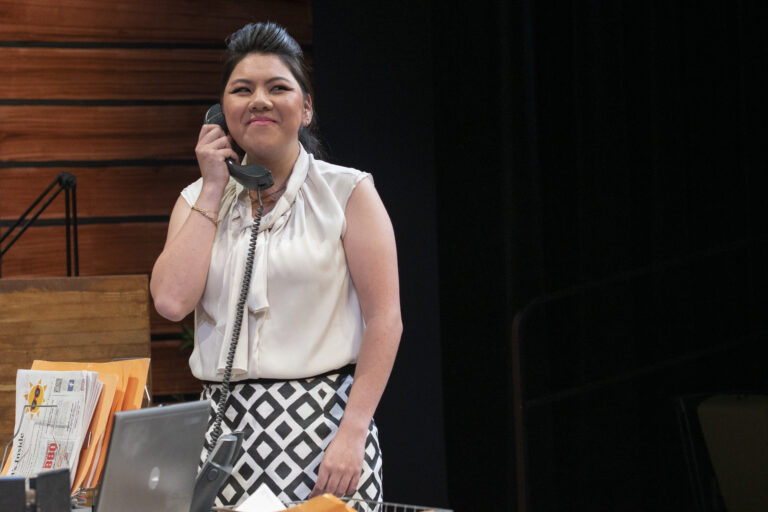
Parton herself collaborated with one of the original screenwriters to come up with 9 to 5, the Musical. The pretty straightforward musical adaptation of the film runs at Santa Rosa’s 6th Street Playhouse through June 26.

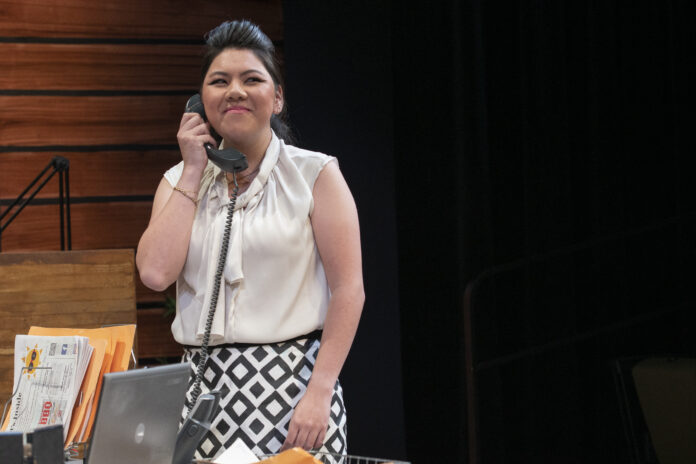
The book of the show closely follows the film script, as three disparate office workers join together to take on their “sexist, egotistical, lying, hypocritical bigot” boss. The too-frequently-overlooked-for-promotion Violet Newstead (Daniela Innocenti Beem) joins forces with the newly-employed Judy Bernly (Julianne Bradbury) and the unfairly maligned secretary-to-the-president Doralee Rhodes (Anne Warren Clark) to bring some equity to the offices of Consolidated Industries and some payback to its loathsome leader, Franklin Hart (Mark Bradbury).

There are minor differences between the film and the stage show, but the basics are all there, plus about a dozen more tunes by Parton. including “Backwoods Barbie.”

Director Carl Jordan has cast the show well. Each of the principals brings a strong voice and clear characterization to the stage. Violet is a good role for Beem, and Bradbury really impresses with her vocals as Judy. Clark has the difficult task of not being too Dolly Parton-ish and succeeds, big hair and all. Mark Bradbury is effectively sleazy as Hart, and Jen Boynton matches well with him as the office busybody.

There’s a large ensemble doing good work in multiple supporting roles, and they do the bulk of the dancing. They also spend a good deal of time moving set pieces around. This show has a lot of moving parts, and credit goes to the ensemble (and stage crew) for keeping the pace up. Credit also to set designer Eric Broadwater for the best-looking set I’ve seen at 6th Street in a while. Projections by Chris Schloemp really complement the sense of place.

9 to 5 is the type of show that delivers exactly what you expect it to deliver, and that includes a couple of appearances by Parton herself. 

‘9 to 5, the Musical’ runs through June 26 in the GK Hardt Theatre at 6th Street Playhouse, 52 W. Sixth St, Santa Rosa. Thurs-Sat, 7:30pm; Sat-Sun, 2pm. $26–$45. Proof of vaccination and masking are required to attend. 707.523.4185. 6thstreeetplayhouse.com

Do Nothing

The most difficult endeavor

By Christian Chensvold

Here’s a simple test to check your health that doesn’t require any medical paraphernalia or professional diagnosis. It’s the simplest thing imaginable, which means in a chaotic age such as ours, only seasoned experts can do it.

Here’s the test: can you sit and do absolutely nothing for five minutes? That is, can you leave the house without your phone, find a bench or a plot of grass, and just be? If you can’t sit alone with yourself for five minutes and not slip into a state of irritability, with a million agitated thoughts running through your mind, then your “mental health” is in serious trouble.

You’re what I call a replicant; you look like a human being from the past, except that you’re a counterfeit version. You got body-snatched, or rather, soul-snatched. Think about it: shouldn’t you be able to sit with your body and your thoughts and not have to auto-lobotomize yourself because of all the anguish and nihilism built up inside, and which only goes away if you distract yourself?

When you start listening to others who’ve awakened to metaphysical reality, you find a recurring theme. Eckhart Tolle became world famous as a spiritual guru, and recounts how after reaching peak suffering and finally awakening, he spent the next two years sitting on park benches in a state of rapt wonder at the mystery of simply being alive.

Once you’ve mastered sitting and doing nothing for five minutes, you can try doing it while imagining yourself as an ancient king or queen, and I’m not being a court jester here. Throughout Greece, Persia, India and the other great spirit-infused kingdoms, the ability to sit on the throne in a state of immutable calm was the visible expression of a sovereign’s divinity. In Egypt, the ability to sit perfectly still with an aura of supreme command was believed to be a supernatural quality of a king or queen that proved their celestial lineage.

After learning to sit in simple tranquility, then with resolve and poise, you may be ready to take up yoga in its higher dimension, and learn to sit in superior calmness to everything external, completely centered to the transcendent dimension within, the part of you that is greater than you. As the great religious historian Mircea Eliade wrote in a seminal study of yoga, body postures are capable of evoking hieratic stillness, the purpose of which is to become transformed into the image of a deity.

And so what began with sitting on a park bench doing nothing becomes the first step on the path to immortality.

Roundup at Rialto

‘Children of the Vine’ screens

With 2.3 million pounds of pesticides and herbicides used annually in Sonoma County—97% on wine grapes, including 30 tons of Roundup, the investigative documentary Children of the Vine couldn’t be more timely. Shot primarily in the famed wine regions of Napa and Sonoma counties, the film makes its debut for a one day showing on July 12 at the Rialto Cinemas, Sebastopol.  It is an unsettling investigation into the controversial herbicide Roundup and its impact on public health.

Directed by filmmaker Brian Lilla, who after moving to Napa Valley to start a family, witnessed the nightmare unfolding around him as farm workers sprayed vineyards with thousands of gallons of Roundup each winter. Beyond the manicured beauty of Napa’s vineyards, Lilla found the wine industry is using more Roundup in vineyards than most agricultural crops. At the center of this controversy is glyphosate, the primary active ingredient in Monsanto’s Roundup. Glyphosate is now found in breast milk, baby food, wine and 80% of food grown in the United States.

Lilla interviewed both farmers who depend on Roundup and those paying the ultimate price for spraying it on their crops. He also digs deep into Monsanto’s misleading science and 40 year campaign that Roundup is “safe as salt.” In the end, Children Of The Vine highlights more sustainable farming practices that don’t put public health at risk and are capable of feeding the world.

With many residents still using Roundup on their properties, the information in this explosive documentary should be a game-changer for local residents and moreover, the ag and wine industry.

The screenings will be followed up with a panel of experts and director Brian Lilla, to answer questions and discuss the options of non-toxic farming practices. Proceeds benefit Neighbors to Preserve Rural Sonoma County.

—Padi Selwyn

Co-chair, Neighbors to Preserve Rural Sonoma County.

‘Children of the Vine’ plays at 3 pm and 7 pm, Tuesday, July 12 at Rialto Cinemas, 6868 McKinley St, Sebastopol. More information at rialtocinemas.com.

Clouded by Coho

Last winter’s coho run spawns hope

By Cole Hershey

The rains of 2021 were a soothing balm to the drying lands of California, filling reservoirs to the edges of dams across Marin and Sonoma counties.

During and proceeding these heavy downpours, many in the media noted the season as a miracle for the coho salmon that live in Lagunitas Creek in Marin County, stretching their spawning across the watershed into areas they have not been seen in over a decade. The rains of late 2021 helped the Lagunitas coho, as in [1] the most plentiful streams in all of California lay nearly 400 nests (called redds), according to preliminary data acquired by the Bohemian.

While this preliminary number is nearly double the coho redds found last year, when looking at seasons historically, the number may have less to do with the rains than many observed.

Coho spend parts of their lives in freshwater and parts of their lives in the ocean. They live in freshwaters for a year and a half before they venture out to the ocean, only returning to breed in their third year of life, after which they pass away. For coho conservationists, the important information to observe is the parent generations and their offspring generations, meaning the salmon spawning season three years prior.

As it currently stands, the coho redd count is higher than the previous generation. The data is still being collected by the National Park Service, Marin Municipal Watershed District, and the Salmon Protection and Watershed Network (SPAWN).

“The generation following has always been greater than the one that preceded it,” said Preston Brown, director of watershed conservation at SPAWN.

“Those rains in December which drew headlines said, ‘Yeah coho! Coho everywhere!’” remarked Brown. “But when you look at it, the number of coho was just a little above average, at least in Lagunitas.”

In the Russian River Watershed of Sonoma County, where coho are known to make redds, the appearance of a large swelling of coho also occurred. The large number of coho observed in this watershed [2] was due to the heavy rains shortening their spawning season, which gave off the appearance of more coho in the stream, according to a recent Sonoma Water report.

Due to the heavy rains before their spawning season began, coho swam further upstream than usual, reaching higher into small tributaries. Since they spread out across the watershed further than usual, it gave the appearance that the run was more bountiful than other years.

“They were in amazingly high places, so it painted this picture that could be sort of misconstrued,” said Brown.

This occurred in Sonoma as well for the threatened Chinook salmon. However, exact numbers are hard to discern, seeing as Chinook are listed as threatened, unlike steelhead and coho, so monitoring their numbers across California has not been prioritized.

“Because the rains were so perfect—they came right at the right time at the right amount of duration—it made these little tributaries full of water,” said Brown. “Coho were getting up into those waters where they hadn’t been seen in maybe 10 years or so.”

As the winter season continued, however, there was very little rain to show, quickly drying Lagunitas creek, which has very little groundwater to maintain its flow throughout the summer. By the beginning of spring in some tributaries further upstream, the pools of water were beginning to lower into trickles.

“We got these coho spawning in these tiny tiny tributaries, and once those eggs hatch and the fish are swimming around, those tributaries [could] start to go dry,” said Brown.

Luckily, the April rains greatly aided the coho living further upstream.

The fact that the coho spawned so far upstream, according to Eric Ettlinger, aquatic ecologist for the Marin Municipal Water District, is the important takeaway from this year’s run of endangered coho. 

“Even if we hadn’t gotten those spring rains, I think salmon spawned in enough places that we would’ve gotten a good juvenile population this year, regardless,” Ettlinger said.

This, Ettlinger explained, is because there was a wider variety of habitats and locations where the salmon could thrive.

“There’s this idea of a portfolio where you want as much diversity as possible in order to maximize your returns,” Ettlinger said. “You want them to have as many options as possible, and this winter we saw that.”

While this year has been a positive moment for coho, steelhead and Chinook alike, California is heading yet again into an exceptionally hot and dry summer, with nearly all of the state in a severe drought.

According to a 2019 report by the National Oceanic and Atmospheric Association, most coho in California are at a very high risk from[3]  climate change, due to a greater sensitivity to ocean acidification, along with water temperatures and other stressors.

“This population here is particularly vulnerable to climate change,” said Ettlinger. “[This] is the southernmost wild coho population in the world, and climate change is going to have the biggest impact on populations [of all species] closer to the equator.”

Due to large-scale fishing, along with habitat loss mainly from large-scale dam building across California, coho have been greatly reduced from their historical numbers, when the streams all across Northern California used to run red with coho. Since their listing as endangered in 1996, coho populations in California have steadily been on the incline.

While there is little to be done to reduce the temperature of ocean water, other than eliminating the use of fossil fuels, there are things to be done to help coho survive in a less hospitable climate.

Marin Water for decades has been adding logs and other plants into streams themselves, something that has been proven to help juvenile coho survive through the summer.

According to Ettlinger, while dams across the county have created many setbacks for the salmon, the release of water from the reservoirs may give coho in Lagunitas a better chance in the future.

“Ironically, the cold water that’s released from our reservoir, Kent Lake, year round may be one of the reasons that this population will persist when other populations in the region are not going to,” Ettlinger said. “So that acts as a buffer against the rise in temperatures that are expected with climate change.”

SPAWN, for one, helps with countless restoration activities across the watershed, such as running a native plant nursery and reestablishing historical floodplains. This June, SPAWN made an agreement with Marin County to implement a new stream conservation ordinance to help protect stream banks and floodplains from building.

However, the work of protecting coho salmon in the North Bay is not relegated just to the small watershed of Lagunitas Creek.

In 2021, a study was conducted in Dry Creek, a small tributary of the Russian River, in order to understand why many smolts, young coho traveling to the ocean, do not make it to the Pacific. While this was the first year of the study using hatchery-caught coho to study the effects of predators on the young fish, it is data Sonoma Water could use in order to inform how they proceed with ongoing restoration projects aimed at saving coho.

One potential tool, which now could be used to help mitigate the effects of drought and climate change on coho in streams, is beavers.

“A group of us are working to reintroduce beavers into Lagunitas Creek,” said Ettlinger. “It would be really beneficial to coho in particular because coho like slow water, they like wood in the channel and beavers can create a really ideal nursery habitat. So that would be a big change.”

In May of this year, the state of California approved five new staff members to lead a beaver restoration assessment program across the state, signaling a shift in how the government may feel about the animals, seeing as the rodent has a great many benefits to the land beyond coho restoration.

It should be noted that beaver relocation is currently illegal under state law, California being one of the few states west of the Rocky mountain range to do so.

With the work of countless individuals across Sonoma and Marin counties, coho are steadily increasing in number, and there is still plenty of reason to hold out hope. According to Brown, coho, a keystone species like the beaver, are critical for the preservation of coastal ecosystems and local economies. Even in Sonoma County, the fish were once so plentiful that there was a cannery in the southern region of the Russian River Watershed.

While coho are still far from those booming numbers, with the tireless work from Marin Municipal Water District, SPAWN and Coho Partnerships in Sonoma County, coho are slowly but surely on the rise.


No Nuke Talk

Normally, I would automatically agree with most anything Norman Solomon has to say. I put him in the same category of Lynn Woolsey and Barbara Boxer, both of whom I greatly respect. But not this time.... There is NO discussion about nuclear weapons that can occur at high government levels that can end well. All that can be said is...

Anxious Crossings – A bridge too far

He did not actually have to face this danger that day when crossing the bridge; what he did have to face was fear itself, and there’s a reason the wise man said that there’s really nothing to fear but fear itself, because it acts so irrationally upon the imagination on which it feeds. Photo by Carl Solder GGB Like a bridge over troubled waters.
By Christian Chensvold As we came out of the tunnel and the bridge came into view, the busload of kids let out a roar, but not my friend Craig seated next to me. He started to squirm, clutching the empty box of Milk Duds, which he’d announced, when we were passing through Novato, that he was going to use to...

DIGABLE PLANETS The jazz-informed hip-hop group will play at the Marin County Fair Sunday, July 3 at 7pm.

Photo courtesy of Clara Franco
Petaluma Sunday Jazz Summer is here and so are the dulcet tones of outdoor jazz. Every Sunday afternoon, stop by the Speakeasy Restaurant in Helen Putnam Plaza to find Live Jazz in Petaluma in full swing. Some of the best jazz musicians in the Bay Area are flocking to the plaza to play together, and there’s a new lineup every weekend....

Astrology – Week of 06/29/22

ARIES (March 21-April 19): In her poem, “Two Skins,” Bahamian writer Lynn Sweeting writes, “There is a moment in every snake’s life when she wears two skins: one you can see, about to be shed, one you cannot see, the skin under the skin, waiting.” I suspect you now have metaphorical resemblances to a snake on the verge of...

Finding Melody – Strauss’ latest solo album 

Strauss went to Hampshire College for writing, but during his studies came across a collection of field recordings of West African music that significantly inspired him. Photo by David Hall
By Jane Vick  Guitarist Walter Strauss has released his third solo album. For Melody, Wherever She May Find Me is the result of an exploration of melodies, both original and covered. During the pandemic, Strauss, an often-touring and collaborating musician, found himself alone with time and his guitar. Without an audience to perform for or players to perform with, Strauss found himself...

Trivia – Week of 06/22/22

1 This treelike southern California plant was so named because its greatly extended branches resembled the outstretched arm of a biblical figure. What unusual tree is this? 2 This bird's name means flame in Portuguese, because of its bright reddish-orange color. What is it? 3 What African-American writer won the Nobel Prize in Literature in 1993 for the “visionary force and...

Workplace Woes

‘9 to 5, the Musical’ clocks in at 6th Street By Harry Duke  It’s been over 40 years since Dolly Parton made her film debut in 9 to 5 and the title tune topped the charts. The film and song (which garnered Parton an Academy Award nomination for Best Original Song) became markers in the struggle for parity in the workplace...

Do Nothing

The most difficult endeavor By Christian Chensvold Here’s a simple test to check your health that doesn’t require any medical paraphernalia or professional diagnosis. It’s the simplest thing imaginable, which means in a chaotic age such as ours, only seasoned experts can do it. Here’s the test: can you sit and do absolutely nothing for five minutes? That is, can you leave...

Roundup at Rialto

‘Children of the Vine’ screens With 2.3 million pounds of pesticides and herbicides used annually in Sonoma County—97% on wine grapes, including 30 tons of Roundup, the investigative documentary Children of the Vine couldn’t be more timely. Shot primarily in the famed wine regions of Napa and Sonoma counties, the film makes its debut for a one day showing on...

Clouded by Coho

Last winter’s coho run spawns hope By Cole Hershey The rains of 2021 were a soothing balm to the drying lands of California, filling reservoirs to the edges of dams across Marin and Sonoma counties. During and proceeding these heavy downpours, many in the media noted the season as a miracle for the coho salmon that live in Lagunitas Creek in Marin...
11,084FansLike
4,446FollowersFollow
6,928FollowersFollow