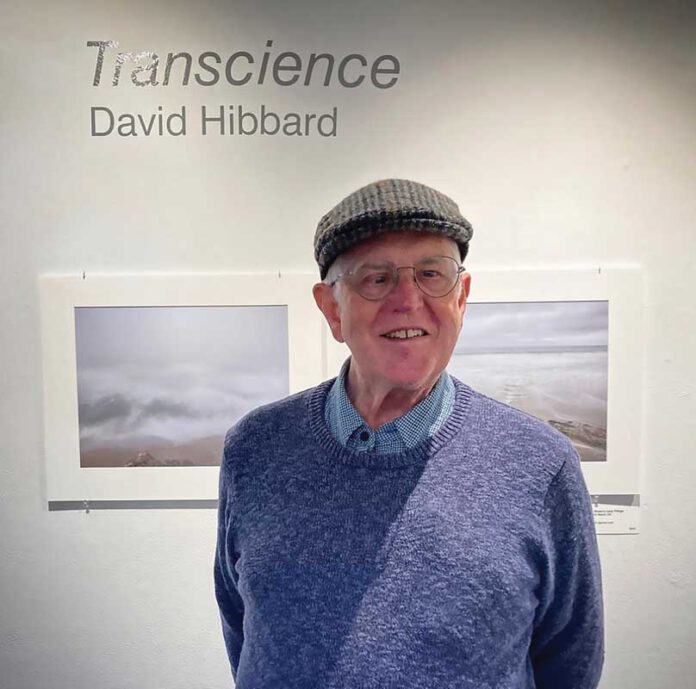
Technologist and poet, my famous uncle has an arresting gaze—for it is like looking at two
separate men. His left eye is hard and penetrating. Hard as a camera lens. Sharp as an eagle’s eye.
His right eye, however, is cock-eyed. Immobile, knocked off center, down and left, this lazy eye gives him a comic appearance.
When looking into someone’s eyes, one naturally focuses on one of them. With almost anyone, which eye doesn’t matter. With David Hibbard’s eyes, one has a choice of two separate men. Is he the keen, penetrating observer or the sweet, shy, sensitive goof?
As a young child, I never understood why he didn’t patch his lazy eye and give himself the roguish sex appeal of a Bond villain. As an adult, sitting him to interview, I finally learned why. Both his eyes are sighted. But each sees the world in radically different ways. Each gives rise to different perspectives and, indeed, different men.
Except within three inches, his left eye sees the world as an impressionistic painter would, as a beautiful field of bright blended colors—with no object recognition at all. This sight gave rise to his poetic side.
His keen right eye sees sharp delineated detail with better than normal vision. It is an analytic eye. But it sees the world flatly.
Unable to coordinate his eyes, David Hibbard lacks the stereoscopic vision that gives rise to the illusion of three-dimensional depth. That he became a photographer seemed, in a way, predestined by the accident of his birth—for him, everything he sees is as flat as a photograph.
His “disability” is called strabismus. It can present, as it now does, in an obvious way. Or it can be outwardly subtle—an invisible disability. His parents were unaware of it. No diagnosis was made. He was slow to develop. Neither walking nor talking at the age of three.
To compensate for his early social awkwardness and sensitivity, they pushed him into virile youth sports such as diving and boxing. Entirely dependent on depth perception, these experiences were humiliating.
Still he did not know why he was different, but his recurrent nightmare monthly—between the ages of 6 and 11—provided an obscure clue. In the nightmare, he would wake in his bed and realize he was shrinking, with his room and bedclothes growing and receding until he disappeared into subatomic space. Only as an adult did he realize the dream reflected his struggles with depth.
Such bruising and nauseating experiences pushed this dreamy child further into solitary pursuits and the solace of nature—where he would delight in changing his perception of gardens and seascapes between his poetic and sharply analytical eyes.
The discovery of the camera was a revelation to him. Peering with one eye into an aperture’s two-dimensional gaze was an affirmation of his way of looking at the world. Photography was his natural language. He excelled. And the solitary and technical aspects of the discipline suited him and led him into a lucrative secondary career in technical writing.
Later, he had his diagnosis: strabismus. And in a flash of revelation, a thousand odd incidents in his life suddenly fit into place within a single pattern. He always knew he was different. Now he knew why. With diagnosis came the option of treatment. But he opted not to treat it or patch his right eye. By that time, his condition was his character, and he was mindful of its gifts and how it guided him down the paths of his life.
Learn more: About David Hibbard: davidhibbardphotography.com. About the author: linktr.ee/cincinnatushibbard.