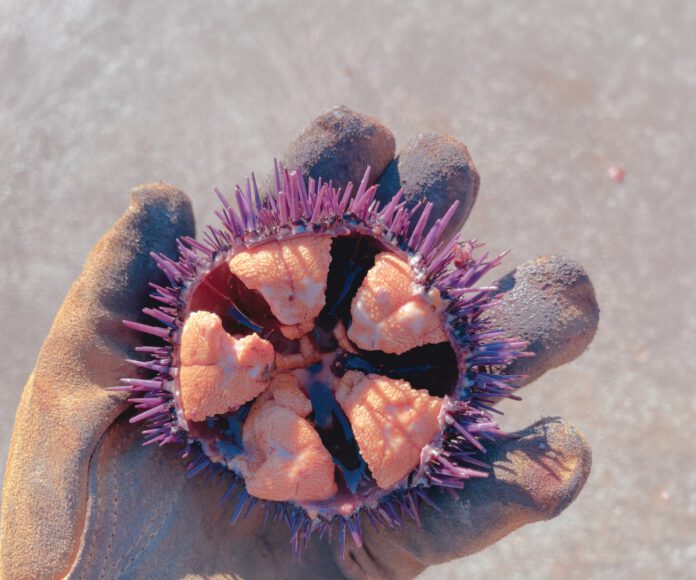
This article contains a hard truth. And hope… And now, here’s the news: Within two years (dating back to 2014), 70% of our orange-brown kelp forests died along a 520-mile stretch of coast, from Monterey, California, to Cape Arago in southern Oregon.
Closer in—along the continuous coastal counties of Marin, Sonoma and Mendocino—95% of the bull kelp forests died. Ninety-five percent. In the 10 years that have followed, there has been no spontaneous recovery.
“It is as if [almost] all the trees in the Sierra Nevada mountain range suddenly died,” said local diver Eric Sedletzky. Or, for that matter, all of the redwoods in the California coastal range. That is not an exaggeration: The Sierra Nevada is approximately 400 miles long; the redwood belt, 450. Nor, upon consideration, are our local kelp forests any less iconic.
Although that usage may be unfamiliar, bull kelp does indeed form underwater “forests.” Branching and waving, bull kelp rises gracefully as trees from their rocky anchorage up to 60 feet to form “canopies” on sparkling surface waters. They form lush ecosystems that, acre for acre, are vastly richer than coastal or Sierra forests.
Juvenile rockfish eat the zooplankton the canopy concentrates. Herring school and spawn in it. Young salmon use it while adapting to saltwater. Seals hunt there and also hide there from great white sharks—the kelp is cover in both directions. Sea lions and gray whales feed at the edges, where mysid shrimp concentrate. Beneath the canopy lay sea stars, nudibranchs, crabs sponges, understory kelps and the pink coralline algae that induce the settlement of young abalone and red urchin. And herons and egrets walk along the kelp, eating those juvenile rockfish.
I could go on and on counting the toll; the Nature Conservancy puts the total at more than 1,000 species relying on kelp forest habitat—now mostly dead.
It is difficult to assess the loss of life among these thousand dependent species. The loss of kelp is often assessed in aerial reconnaissance flights that count the remaining surface canopies. With the loss of 70 to 95% of the ecosystem, the death toll below the surface is simply unfathomable.
Where the dead are closely counted, in the commercial fisheries, the collapsed and closed abalone and red urchin fisheries are one indication. The recreational abalone fishery alone carried a $44 million annual value; the commercial red urchin catch, $3 million more. Both are now gone. The state of California is expected to extend the abalone moratorium another 10 years.
I myself was shocked and sickened to find that I have lived, worked and played a mere 20 miles from such an overwhelming loss of life. A mega-death; a giga-death; an ecocide. Some 5 billion sunflower sea stars alone have died along the Pacific coast, and in terms of ecosystem function, now functionally extinct.
I find myself asking, once again: Where are the alarms, where are the shouts—where is the blaring news coverage? And the massive government led mobilization to put out this consuming fire?
Like so many of my stories, this one is, deep down, about why the news matters—why news writing and news reading matter. Why local nonprofits matter. And why the action of individual people matters. That motivates my service as a citizen journalist and story-teller.
In the face of a state government broken and slow, and a federal government corrupt and hostile, citizens sick and tired of being sick and tired must look to themselves. And in this article, I offer a hopeful example.
Local Action
Eric Sedletzky is a recreational scuba diver. As he tells it, his story began with fatigue. He was sick and tired of looking at endless purple urchins on his dives. Over two horrific years, Sedletzky had watched firsthand as the “perfect storm” decimated the kelp forest ecosystem at his favorite Stillwater Cove.
The same three causes are everywhere along this coast: an ocean heatwave that stressed the kelp; a mysterious “wasting disease” that turned the 24-limbed tangerine, purple and gold sunflower star to fetid goo in days, killing 90% in the largest marine epidemic on record; and the purple urchin the star had eaten, released to multiply 10,000-fold (and mow down the forest). The reader can guess the cause behind these causes…
What is left are vast “urchin barrens.” At one assessed site—Orford Reef in southern Oregon, which once held half the state total, state biologists estimated roughly 350 million purple urchins—and little else.
Once they have eaten all of the kelp, urchins can lie in a dormant state of “zombification” for as much as 50 years by slowing their metabolism and slowly eating themselves alive. There’s no waiting them out.
That is what Sedletzky saw, swimming below the waves: tens of thousands of them on the rocky bottom of Stillwater Cove on the Sonoma Coast. But he also saw something that gave him a thin ray of hope : a small band of algae near the surf the urchins couldn’t reach, where a few remaining abalone eked out a lean existence.
He was sick of urchins, and government inaction too. So one day he decided to do it himself and expand that margin just a little— removing the spiny urchins by hand. When I first interviewed him, I confessed that I had felt powerless when I heard about the magnitude of our loss on the coast. He told me that he regained his agency by narrowing his focus onto his own locality—a tiny piece of the problem he could touch and change: his own beloved Stillwater Cove.
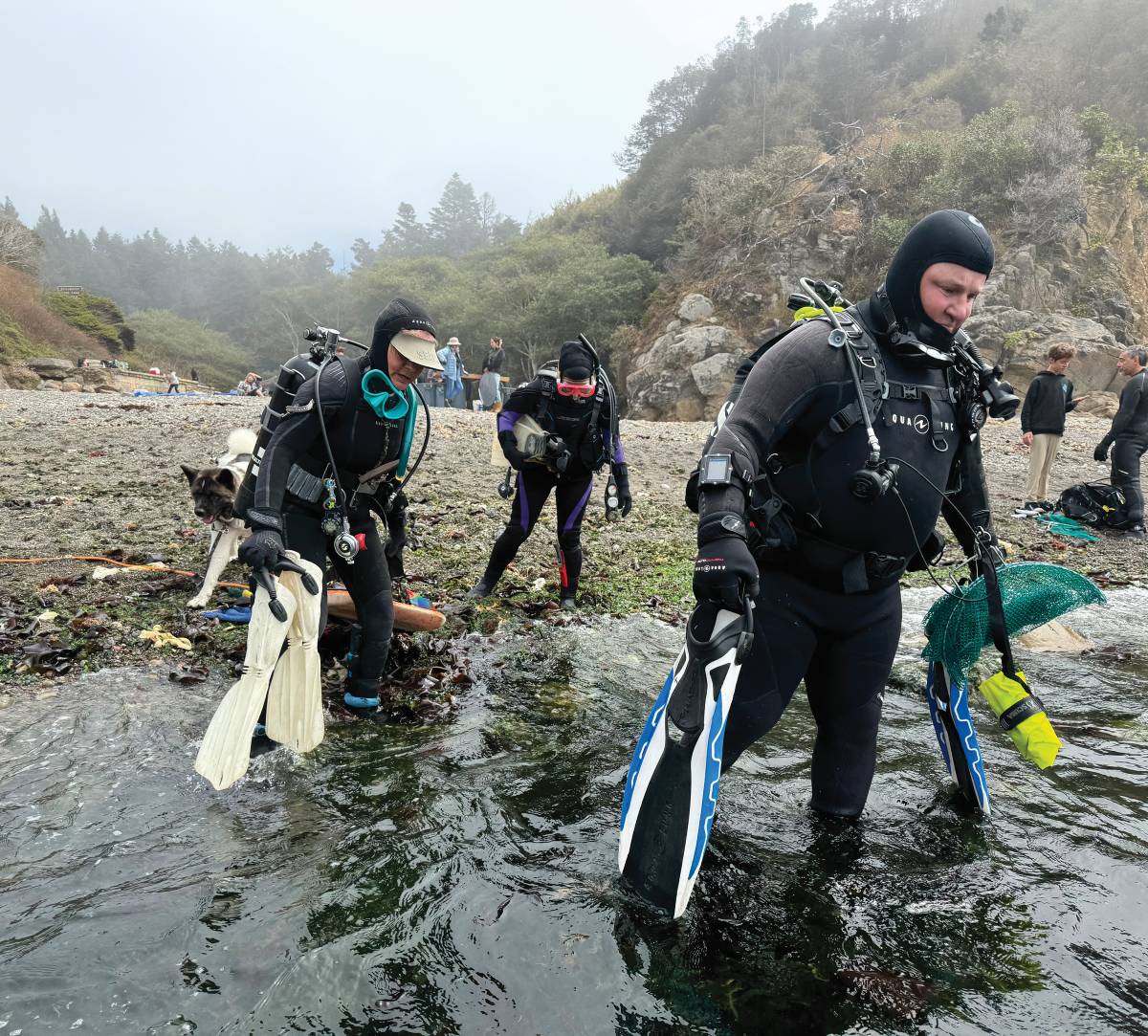
Photo courtesy of PURP.
That is the principle I want people to take away and apply (to our social problems). I suggest they focus on one trash-filled creek, one homeless camper, one butterfly garden, one scared immigrant family where they live. They should put the vastness of the problem in the periphery and focus on the small piece in front of them. Whether or not it joins a larger effort, they will have improved their own quality of life and peace of mind.
Sedletzky had real success on his small piece of the problem. Then he got ambitious: Perhaps he could clear the whole seven-acre cove. But he needed help. He reached out to Seals Watersports (a Santa Rosa dive shop that closed as I was researching this story, a piece of the ongoing economic impact) and to its “fun diver” list. He established the Purple Urchin Removal Project, PURP, hosting weekly catches, with non-divers processing on shore.
PURP’s local success was then recognized by the Greater Farallones Association, a conservancy associated with the federal marine sanctuaries between Point Arena, in Mendocino County, and the Golden Gate. Stillwater Cove is now one of its five test sites for kelp replanting.
Talking to the Association’s Rietta Hohman and Julieta Gomez, I found them optimistic. But optimistic in the context of a decade of ecocide and inaction: two years to public acknowledgment, six to the first state dollar spent on kelp and 12—so far—to no finished rulebook. I speak of the Kelp Restoration and Management Plan, a statewide adaptive plan now in development, with a restoration toolkit and a working group of stakeholders, scientists and tribes.
There are more hopeful rays: Researchers at the University of British Columbia, the Hakai Institute and the University of Washington identified the bacterial cause of the wasting disease in 2025. The San Diego Zoo Wildlife Alliance has successfully stored sunflower star sperm and eggs. Small breeding and reintroduction experiments have begun in Monterey Bay. Hope—for a species still functionally extinct in California and Oregon.
The project to build back just 1% of what was lost has begun.
For now, both the California and Oregon state plans focus on culling. Which is to say, humans stepping into the ecological role of the absent sunflower sea star and becoming the urchin’s predator.
So here is a final ecological principle. Most ecosystems that remain are reduced, stressed and fragmented. That was the condition off this coast before the collapse. To save what remains, humans will increasingly have to take on the roles of functionally extinct species: becoming a pollinator here, nursery there, predator out there. It is not just what is owed. It is how we save humanity. It will take redirection and a massive effort.
Efforts like Sedletzky’s are the beginning. I asked him how he likes to eat his prey, and he replied: “Plain, raw, fresh from the sea, with a splash of sea water for salt.”
Learn more: Eric Sedletzky’s urchin clearing PURP can be found on Facebook, and on Instagram at @p.u.r.p_707. Volunteers are needed. The kelp planting Greater
Farallones Association seeks donations via farallones.org. The North Coast Kelp Fest takes place Oct. 9-12 in Mendocino and Ft. Bragg; visit northcoastkelpfest.org. Note: This story is thematically-linked to ‘Another Silent Spring,’ about accelerating mass extinction, available at bohemian.com.