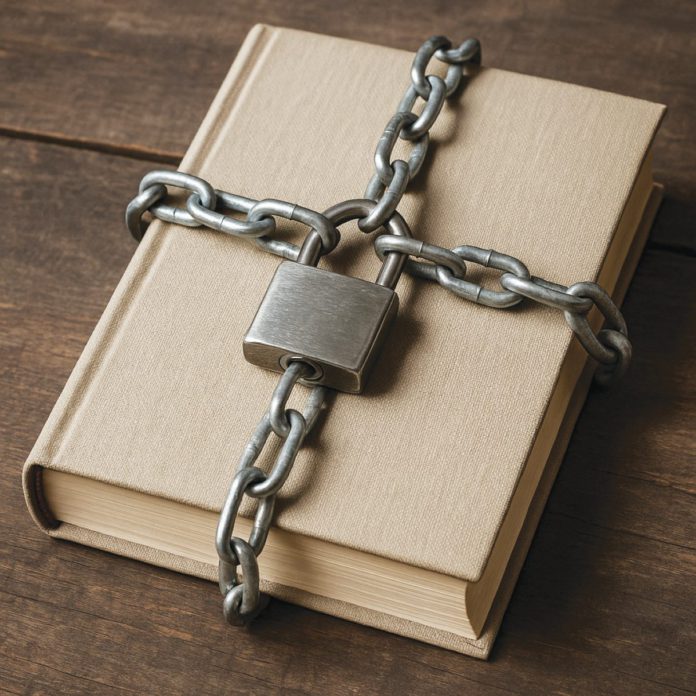
The theme for this past October’s Banned Books Week was in keeping with the multi-front assault on civil liberties, freedom of speech and press freedoms during the second Trump administration: “Censorship Is So 1984: Read for Your Rights.”
This was a clear nod to George Orwell’s dystopian novel, which warned against creeping authoritarianism, including the control of language and thought, accompanied by the rise of a techno-surveillance state that coerces the public into compliance using the strong-arm tactics of fear, intimidation and censorship.
In 2025, the United States is becoming increasingly unrecognizable as its freedoms protected under the Bill of Rights are being shredded, one by one, in the name of superpatriotism and national security, allegedly to “Make America Great Again.”
We are witnessing an attack on the entire knowledge industry, encompassing K-12 and higher education, as well as the mass media and the Fourth Estate. This impacts teachers, students, librarians, professors and everyday Americans, some of whom are even losing their jobs for expressing their First Amendment-protected views about our current volatile political climate.
In short, there is not only a war on the public’s right to read, to learn and to know, but to protest and dissent against an increasingly draconian regime in Washington.
Targeted efforts to control what schools can teach, what the media can disseminate and what students can learn and read have been on the rise since the first Trump administration and have reached a fever pitch in his second term, contributing to the ongoing culture wars. Earlier this year, during National Library Week (April 6-12), the ALA released data documenting attempts to challenge and remove books and materials in public schools and academic libraries during 2024.
Their research shows that most book censorship attempts now come from organized movements, not individuals, noting that, “Pressure groups and government entities that include elected officials, board members, and administrators initiated 72 percent of demands to censor books in school and public libraries.” These censorious efforts overwhelmingly come from the political right.
Parents accounted for 16% of the challenges, while 12% came from library users, teachers, librarians and other staff members. In context, while “the number of reports decreased in 2024, the number of documented attempts to censor books continues to far exceed the numbers prior to 2020.”
PEN America documented “nearly 16,000 book bans in public schools nationwide since 2021, a number not seen since the Red Scare McCarthy era of the 1950s.” PEN’s November 2024 study, “Banned in the USA: Beyond the Shelves,” showed that Florida and Iowa led the way on book bans, with a significantly disproportionate amount of the banned books involving people of color or the LGBTQIA+ community.
Coupled with the many attempts to stifle dissent and restrict free expression to views approved by the current administration, this does not bode well for the future of our republic. That said, there are many heartening efforts afoot to reverse these trends in support of academic freedom and the right to read, especially from the nation’s youth. They have something to teach us and are very deserving of increased support.
Students Fight Back
Today’s students are not only the leaders of tomorrow. Across the nation, young people are trailblazing today, from school classrooms to the halls of state legislatures and even the U.S. Supreme Court. These young changemakers want a seat at the table and are not waiting around as book bans ravage their schools and communities in an effort to erase certain ideas and identities. Student advocates are speaking above the floodline of censorship to defend their freedom to read, learn and access information.
The social media campaign #BreakTheTape is using caution tape as a visual symbol to challenge intellectual censorship. This initiative began in California with the student organization Golden State Readers and has amassed a nationwide digital footprint. The campaign aims to center and elevate student representation in education policy decisions that affect students, particularly those related to access to school library books.
“Wrapping backpacks, books and other school supplies in caution tape is a simple and accessible way for students to visibly demonstrate their support for their freedom to read,” Elizabeth Goldman, co-president of Golden State Readers, said. “Over the last two years, we’ve wrapped 1,800 backpacks across eight states. Each year that #BreakTheTape grows, we prove that the harder they try to censor our literature, the harder we as students—nationwide—will continue to stand up and fight for our own freedom to read.”
SEAT at the Table
Meanwhile, Students Engaged in Advancing Texas (SEAT) is a movement of young people who recognize that students are the primary stakeholders in education. Established on the national momentum of the students’ school board advocacy in Katy, Texas, SEAT is on a mission to ensure every student has the tools to shape their own futures.
In organizing against book bans by school boards across Texas, SEAT has distributed hundreds of banned books and “Know Your Rights” lanyards designed to educate students about their constitutional freedoms. Delivering testimony while donning pride flags and SEAT lapel pins, symbolizing students’ seats at the table, SEAT has gained national momentum, bringing its advocacy to Washington, DC.
Members of Congress wear SEAT pins in solidarity, and the student advocates have testified to the U.S. Senate. The group has been featured in viral clips, including one shown on Jimmy Kimmel Live!. In April, SEAT filed the only amicus brief representing students in the Supreme Court case, Mahmoud v. Taylor.
“So often, student voices are decentralized in the conversation about book banning. But at the end of the day, book bans directly impact students: students who want to see themselves reflected in the books they read,” Goldman noted. “Diverse literature plays such a key role in fostering empathy among adolescents and allows students to better understand themselves and the world around them. Depriving students [of] their freedom to read what they choose forcibly narrows their scope of the world and themselves.”
As Orwell cautioned in 1984, “Who controls the past controls the future: who controls the present controls the past.” Asserting our rights to read is one way to oppose the erasure of entire communities and significant, if troubling, aspects of our country’s history. Affirming the right to read is also a powerful way to oppose the current administration’s Orwellian efforts to redefine lies as truth.
Mickey Huff is the director of Project Censored. Cameron Samuels is the cofounder and executive director of Students Engaged in Advancing Texas.