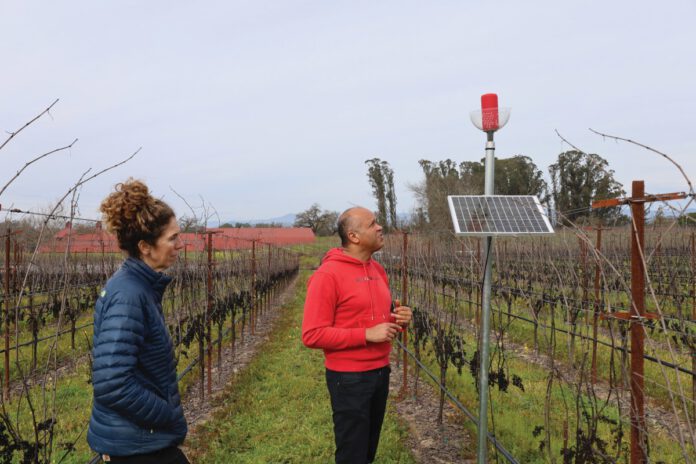
At 2pm on a Saturday, “Frère Jacques,” a classic French nursery rhyme, flows from a red speaker mounted on a metal pole with a solar panel in a dormant vineyard in the Russian River Valley in Santa Rosa.
The music, regulated from a customized app, RegenApp, plays for two minutes, vibrating through the bare vines, which are budding, with the aim of stimulating photosynthesis, essential for the growth and well-being of the grapevines.
Regina Martinelli, owner of the 14-acre vineyard, part of the Martinelli Winery, hopes the music played at a one-hour interval from dawn to dusk will be the only thing the vines need to grow this year, having tested the technology in 2024 alongside fertilizers and pesticides. She thought the music that year made the plants vibrant and healthier, so if everything goes according to plan, she would not need to fertilize or spray during cultivation.
“[I’m] curiously experimenting with it and being open-minded,” said Martinelli, who doesn’t yet have a buyer for her grapes after her previous client went bankrupt in 2025 following a drop in wine consumption across the country. She said she will only apply sulphur to amend the soil and not to feed the vines.
The device known as Quantum Sphere Helios 2 is developed by mathetician and musician Archippe Yepmou, and it’s being experimented in two farms in the Russian River Valley, with the aim of expanding to other farms in Santa Rosa and Napa Valley.
Yepmou developed the technology in 2015 when he completed his research on rhythmic patterns and pulsation, the mathematical method time is beaten in music. To understand the mathematics behind music patterns, the classical musician used calculus and the equal temperament scale—a universal mathematical algorithm used to set up modern instruments—to recalculate what he believed was the original pulse of music to create his own pattern.
When he played the patterns on a piano for six months in his Paris apartment, he noticed the plants in his neighborhood blossomed more than that of his neighbors. He thought the music had a positive effect on them.
“When I told my wife about it, she said I was crazy,” Yepmou said.
To move beyond his curiosity and prove that he wasn’t just hallucinating, he collaborated with the City of Paris and the Polytechnic Institute in Paris to test the finding before setting up a greenhouse laboratory on the windy mountains of Woodside, San Mateo County.
“I wanted to test the technology in a very complex environment with a lot of wind and different plants,” Yepmou said. He noted that the vegetables and tomatoes he planted in Woodside had an explosive growth, including the sequoia trees around it, because of the music patterns he played systematically.
There are numerous studies proving that plants are sensitive to music. A 2004 study published in the Environment and Conservation Journal in 2023 found that sound vibration increased the number of roots and lengths of the kiwi plant. One kHz with 100 dB boosted the Adenosine Triphosphate (ATP) content of the plant, which determines how much energy a plant has for growth, nutrients transfer and defense against pests and diseases.
Sounds can affect the growth of plants negatively or positively, said Dr. Laurent Bekale, a Stanford University biophysicist. Bekale pointed out that either the Quantum Sphere sounds are creating the ideal environment (influencing soil-enriching organisms) for growth of the vines or the sound is solely impacting the plant. “The hypothesis that can be tested in the lab is to validate whether the sounds directly impact the [vines] plants,” Bekale added.
Ryan Maier of Maier Vineyard Management had listened to a similar study in a podcast before Yepmou approached him one spring afternoon in 2023 when he was mowing a plus 30-year-old pinot noir vineyard just in front of Yepmou’s house in the Russian River Valley. Yepmou moved from Woodside to the area with the aim of testing his technology on vines there.
“When he told me about music helping vineyards to grow, I was skeptical and at the same time curious,” Maier said. He noted that a friend had sent him a podcast about vine owners in France playing Mozart to enhance growth, and he’d dismissed the article for being mystical. Maier recalled having a fascinating conversation with Yepmou, though they didn’t agree to collaborate on the technology.
But two seasons later, he noticed invigoration and dark-green pigmentation from the side of the vineyard a few feet to Yepmou’s house, because he’d been playing the sounds in his yard full of trees, including redwood. “The portion which was in front of (Yepmou’s) house was extremely stunted,” Maier said. He explained that the stuntedness is because of the giant trees shading the vines from sunlight and their roots competing with the vines in soil penetration.
“The next time (Yepmou) approached me, I had become a believer of the music,” Maier said. He had done his own research about how music vibrations can improve photosynthesis in plants, so when he and Yepmou had another discussion about the project in spring 2025, they were on the same page.
“He says to me, ‘Ryan, don’t spray any fungicides,’ and I thought that was a huge risk,” Maier said, fearing the vines would be vulnerable to powdery mildew. But he used just the sounds without any fertilizers and pesticides.
“The vines were mildew-free, and yields climbed from four tonnes per acre to seven,” Maier recalled. Yepmou said they tested the grapes for wine-making, and they were of high quality.
Maier, who’s been working with wine growers in Sonoma County for almost a decade, has partnered with Yepmou to translate the wonders of Quantum Sphere to farmers. He said adopting the technology will help farmers reduce fertilizer, pesticides and labor cost to 70%. “[It can save farmers] $10,000 an acre,” he noted.
But he says most farmers are hesitant to pivot, as they’re still dealing with market shocks and are reluctant to abandon traditional cultivation methods passed down for generations.
Martinelli, whose family started growing grapes in the land in the 1880s, is willing to go all out with the sound patterns. But if she gets a buyer for her grapes, it will be down to how the buyer wants the grapes to be cultivated. Yet using sound energy to stimulate growth resonates with her, as she’s a life coach, using energetics and quantum field to help her clients to be emotionally sovereign.
“If it goes really well, it can really change the landscape of how farming happens,” Martinelli said. “We could spray less, which makes better ground soil [and water].”