
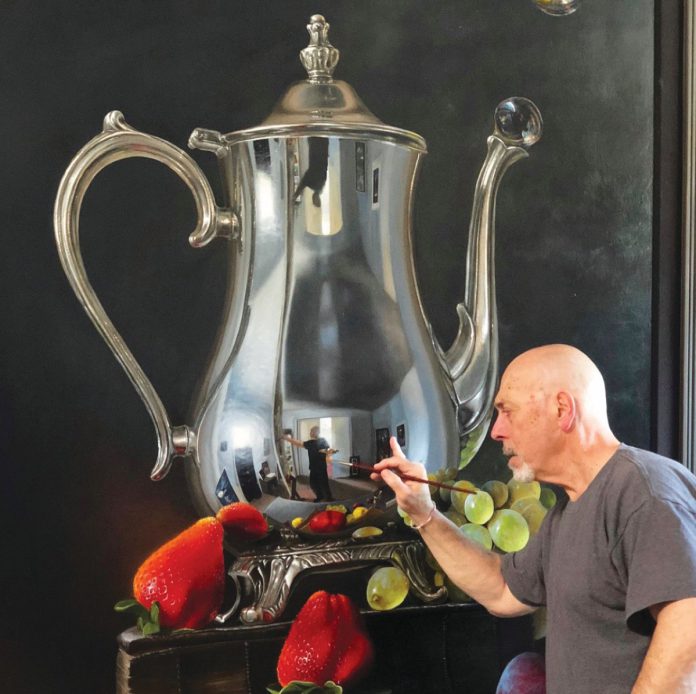
Some people create magic, and some people exude magic. And some people, like late Sonoma County painter Charles Robert Becker, synergize both qualities to an uncanny degree.
Born in 1952, Becker grew up in Millbrae and spent most of his adult life in the North Bay. As a 19-year-old hippie, he met and studied under Italian still-life master painter Roberto Lupetti. From that experience, he developed his own unique style of painting, which eventually brought him international recognition.
His work defied easy categorization. Some called it still life, or nature morte—“dead nature”—but that description didn’t do justice to the unusually lustrous quality of the imagery he painted.
Said San Francisco-based Weinstein Gallery proprietor Rowland Weinstein, who signed Becker on as his first living artist and sold Becker’s paintings exclusively from 1993–2009: “… Charles’ work was so alive to me—you could take the strawberries right off the canvas, you know. You could pick up the doily. There was something so beautiful, so complete to me; it almost wasn’t like he was painting a strawberry. He was painting a portrait of a strawberry; he was painting a portrait of a plum. He was painting them like he was painting individuals.”
In time, Becker’s style came to be termed Magical Realism. In 1986, a painting of his appeared on the cover of Southwest Art Magazine, giving him widespread recognition, and in 1990 Absolut Vodka commissioned him to paint four pieces for a highly successful ad campaign, further vaulting him into the spotlight. He was featured in Time magazine, USA Today and many more publications, and his paintings appeared in galleries, exhibitions and private collections both nationally and internationally.
Those close to Becker make it clear that the magic in his paintings stemmed from him; that the man and his art were inextricably linked, each as extraordinary as the other.
“Any discussion of Charles’ work has to start with who he was as a person,” said Becker’s partner, Amanda Roze. “Each of his actions originated in love—each gesture, brushstroke and communication was filled with beauty and heart… He tried to translate all of his emotions onto the canvas and reach the hearts of the viewers. He used art as a means to connect with people.”
The effect of Becker’s paintings on those who owned or worked among them can’t be overstated.
“Charles’ work can’t disappear into the wall,” Weinstein said. “Once you had a painting of his, it brought you back into it every time you walked by it. It wasn’t on the wall to be a beautiful decoration to complete a corner.”
For many years, Becker operated two studios in Graton, while living in Sebastopol. From one, he taught Bay Area students in-person and distance students online, and in the other, he painted and displayed his work. He lived in Santa Rosa in his later years.
“The task I have undertaken, the journey I am on, is to question, to use all of my emotions, be they joy or pain, peace or passion, to believe in the creation of magic and record it on canvas,” he said. “This is what it means to be an artist. This is what it means to be alive.”
Charles Robert Becker died Jan. 21 at age 73, surrounded by family in Sonoma County. He leaves behind a lasting legacy to the many people, near and far, who marveled at the magic that flowed through him and his art. A Celebration of Life was conducted on Saturday, Feb. 14, at Harmony Elementary School in Occidental.
To learn more about Charles Becker, visit charlesbecker.com.










Charles was a lovely man and brilliant artist, he was my wonderful friend! Bobby G !