
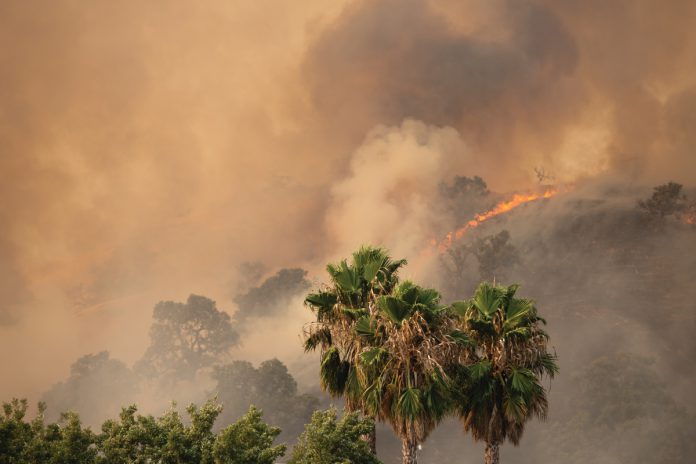
Growing up, I listened to a folk song with the chorus, “Fire, fire, from every rooftop, I heard the cry.” But I didn’t shout “fire, fire” until I arrived in California and began to survive fire seasons that traditionally began when the rains stopped and ended when they started again.
Now of course, fire season can be anytime of the year and “fire country” can be anywhere and everywhere in the state, as the January 2025 fires in Los Angeles and San Diego County—which caused $61. 2 billion in damages—made abundantly clear.
“Why do you want to go to California?” a friend asked me when I went on the road and headed west. She added, “They have earthquakes there.”
She didn’t know and neither did I about fire, smoke and drought, too. In Sonoma County, I watched a wild fire leap across the 101, devour million dollar homes, incinerate Coffey Park, fill the air with smoke and force residents to flee their homes and seek shelter elsewhere. I learned that Native Americans used fire as a tool and in beneficial ways, and that fire was an essential and necessary part of the landscape that made for rebirth and rejuvenation.
“It’s not a foe but a friend,” a woman at the Sonoma Ecology Center told me as we walked across a blackened landscape where green growth emerged.
Most of the 12 contributors to the book Red Flag Warning (AK Press; $18) emphasize the sense of community and fellowship that has emerged in the wake of wildfires, though some of them don’t ignore the hardship, the sadness and the destruction.
Sunday, Feb. 15, the Occidental Center for the Arts Literary Series hosts collection contributors Manjula Martin, Hiya Swanhuyser, Beatrice Camacho and Amy Elizabeth Robinson.
As Canadian born author Naomi Klein observed in The Shock Doctrine and The Battle for Paradise—which can read like rejoinders to Rebecca Solnit’s A Paradise Built in Hell: The Extraordinary Communities that Arise in Disaster and Hope in the Dark: Untold Histories, Wild Possibilities—capitalism has a way of seizing on misery and squeezing profits from fires, earthquakes, tornados, droughts and more.
In Parenting in Fire Country, Dani Burlison, the co-editor of Red Flag Warning, interviews Kailea Loften, an African American citizen of Liard First Nation and a member of the Tsesk’ye clan who has served as the climate commissioner for the City of Petaluma. That the contributors to this volume come from diverse cultures and backgrounds is probably its strongest recommendation.
Loften seems to stand with Klein and not Solnit, but maybe I’m reading too much into her comments. Still, she says, “We are in compounding crises.” She finds fault with people who say, “I’m an optimist” and who think that “if they just keep hoping or keep wishing, it’ll be okay.” Loften complains about the “space of toxic positivity” and adds, “We’re being constantly gaslit.”
I’ve long stood with U.S. Sen. Elizabeth Warren, who has jousted with people who harp on hope. Warren insists that hope is largely meaningless unless it’s joined to meaningful political action.
Fortunately, Burlison, whose name and essays ought to be familiar to readers of the Bohemian and Pacific Sun, writes about what might be called the psychology of fire in “What Wildfires Do To Our Minds.” Her essay is based in part on a conversation with Mary Good, a therapist, ecopsychologist and California naturalist who took on as patients, pro bono, “fire survivors” to help them navigate the “aftermath of disaster.” Good tells Burlison, “It was an absolute trauma for everybody involved.” She adds, “The fire is over, but the grief may last a long time.” There’s no sugar coating trauma and no shortcut through the stages of grief.
Burlison reminds readers that “Low income and other marginalized communities are disproportionately impacted by climate disasters like the frequent firestorms we experience here in Northern California.” She suggests that marginalized individuals need “mental health services” as well as “community support and mutual aid.” Hell, they need homes, jobs, child care and more.
Another section of the book that I read and reread and that I love is an interview Burlison conducted with Brandon Smith, a formerly incarcerated firefighter with the Forestry and Fire Recruitment Program who earned $2-5 per day with an additional $1-2 per hour while serving on an active fire.
Smith walked the walk and talks the talk. No obfuscation from him. “There’s something that’s very cleansing about fire,” he says. By fighting fire, he learned about fire and fire fighters like himself. “A fire camp is a half prison, half fire station where currently incarcerated people work as firefighters,” he says.
I enjoyed his candor, and Jane Braxton Little’s description of throwing the I Ching the night her town burned down and the community lost its post office, drug and hardware stores, library and 1,000 homes. “Climate disaster is the disaster lurking for all of us,” she says. “Fire delivers it to some, floods, drought and famine to others.” All those things no one warned me about when I left New York and came to California.
I would be remiss if I didn’t mention the first essay in the book, which has the catchy title, “Solidarity, Not Charity,” by Weeklys contributor Hiya Swanhuyser. The word disaster, she explains, means “no stars,” in other words, a world in darkness. She also informs readers that the phrase “mutual aid” comes from Peter Kropotkin, the 19th- and 20th-century Russian anarchist and scientist. Swanhuyser plugs Rebecca’s Solnit’s A Paradise Built in Hell, but ends her essay with the sobering thought, “We are headed for disaster.”
On the way to a dark world, read Swanhuyser’s essay and all the other illuminating words that light up Red Flag Warning.
The ‘Red Flag Warning’ literary event begins at 2pm, Sunday, Feb. 15, at the Occidental Center for the Arts, 3850 Doris Murphy Ct. Free. More info at bit.ly/red-flag-oca.









Check the day, 15th is Sunday