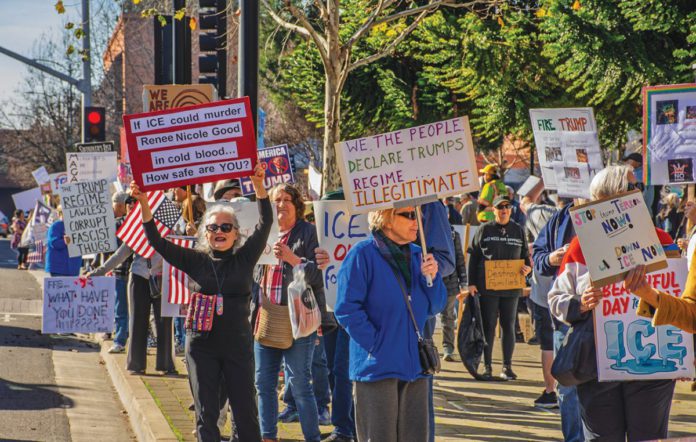
This is the third and final piece of a three-part series on ongoing issues with U.S. Immigration and Customs Enforcement as it reaches into our areas. -–Editor
Part 3: Fear Is Control
“Freedom from fear” was the fourth of four freedoms defining democracy President Franklin D. Roosevelt framed in his rally cry to fight fascist conquest from without. It is openly debated whether America is now fighting a fascist takeover from within.
It may be debated, but only because the would-be dictators of the world will always disguise their plays for power in the mock forms of democratic legality (e.g., declaring a fake emergency, attacking political rivals through trumped-up legal charges or holding rigged elections).
But there can be no disguising the fear. Fear is how authoritarians maintain control, how they keep the people head down and silent—hardworking, obsequious, compliant. In any country in the world, the questions, “Do you fear the president?,” “Do you fear the government?” and “Do you fear the police?” cut through the political lies to the truth.
Wherever one stands on the political spectrum running blue, purple, red, there can be no doubt that in America a great fear is rising.
Fighting Fear Itself
“Power, not panic” is the slogan with which “immigrant defense coordinator” Gina Garibo signs off every email. I was always relieved to see it. In the process of my research, I met a great many professionals, protesters and volunteers just like Gina, “Esteban” and “Marisol.” Some are working openly. And some are working in the new underground resistance.
They are part of a great mobilization of people gathering around a strategic arc of methods for confronting ICE terror. It is a thrilling thing to witness, but still much more support is needed if they are to succeed. “Expanded capacity” is the watchword among these groups.
Trump’s “Big Beautiful Bill” passed last summer by a cowed millionaire’s Congress that doubled the ICE budget to $80 billion. A crash recruitment drive is setting targets to recruit another 18,000 officers to the president’s private police force (The Economist, “Trumpforce”).
California is a “sanctuary state” with the highest percentage of undocumented people in the U.S. (7%). It is governed by one of Trump’s strongest opponents now and in the 2028 election—democratic Gov. Gavin Newsom. California is going to be heavily targeted. ICE will return to San Francisco. “It’s going to get a lot worse before it gets better,” “Esteban” told me when we first met at the “American nostalgia” diner.
The activists I spoke to invite our readers to look at these elements of their adapting strategy and try to find their part in it. Whether our readers are motivated by the fight for immigrants’ human rights and dignity, or to fight for the rights of the poor, minority rights, anti-racism, the fight against the billionaires, public safety, national security, or by the preservation of our constitutional rights, these activists urge them to find their part in this fight. ICE is now the flashpoint in the fight against fear. Use these terms and names to begin one’s own research. Be brave; be unafraid. Fight.
Sanctuary States, Counties and Cities
Sanctuary declarations are based in constitutional law which except state and local officials in assisting in the enforcement of federal laws. The phrase “sanctuary” relates these laws to a religious tradition of sacred sanctuaries for the oppressed, amplifying moral outrage at their violation. Ultimately, they are a local declaration of passive non-cooperation with ICE—with no necessary commitment to resistance or to assistance to those who are fighting.
Putting Pressure on Elected Officials
Claudia Rios Manzo, the program director of the Sacramento F.U.E.L., a network of organizations for immigrants, recommended this key piece. Ask elected representatives what they are doing to actively support our undocumented neighbors. Through funding and partnerships, local government can support those actively fighting ICE terror for all of us. Help them be brave; even U.S. senators feel unsafe in this terror.
Boycotts
Conscientious consumerism quietly remains one of our most powerful political tools. In this way, the people can lead powerful corporations that have no morality but will always follow the money like cattle. Don’t buy from the corporations that have contributed to Trump in the last year or have contracts to supply ICE. If one has stocks in these companies—dump them.
Marches
Along with local chapters of No Kings, a host of local and national groups are organizing a wide range of non-violent protests across the Bay Area. There are many calendars—I suggest the calendar at actiontogetherwest.org. I would also recommend Gene Sharp’s “Methods of Non Violent Action.” Boycotts and marches are just two of the 198 methods of resistance listed in its pages.
Be Out
This part of resistance was advised by activists, especially for Latinos and for persons of color. It is advice for all the communities that feel targeted by this administration (such as LGBTQ persons):
Be safe. Take care of oneself. And to the extent that it is consistent with safety (in one’s personal assessment), be out. Continue to go out—show one’s face; be loud; take one’s place; be proud. Gather. Dance. Live lives as free people. It is a political act. It is effective resistance. They want people to hide, and hide who they are. Be out.
Allies are advised to recognize, honor and support this everyday courage.
Talk About These Issues
Use platforms to keep these issues out in front. Have conversations with friends and family. Continue to educate oneself.
Print and Digitally Distribute Red Cards / Tarajetas Rojas
These index cards, available in 56 languages, have been prepared by the influential Immigrant Legal Resource Center. They have constitutionally protected immigrant rights printed on one side, and a script for talking to ICE agents on the other.
Keep the Number of One’s Local Rapid Response Network on One’s Phone
These networks collect and verify crowdsourced ICE sightings in one’s area and send trained legal monitors to observe and document ICE activity and arrests.
Look up “California Rapid Response Networks” to find one’s local network. And read up on how to identify ICE—false alarms fan the fear.
Train to Be a Legal Observer
Abigail [redacted], a legal observer for rapid response, suggested going to a training by one’s local network without commitment and “make your own assessment of personal risk” after. Some trainees may choose to become rapid responders, others to participate in “adopt-a-school” or “adopt-a-day labor site” programs or be observers at community events that might be targeted. Still other trainees become public sources of good information.
Besides adding to the safety of our immigrant friends and neighbors, observers’ video documentation discourages rights abuses by ICE agents, helps identify detained persons for family and becomes evidence in deportation hearings.
If One Is an Attorney, Consider Volunteering
There are corresponding rapid response networks for defense attorneys. Contact the Immigrant Legal Resource Center or one’s local rapid response network to learn more.
Volunteer
Donate time and skills to local immigrant rights groups. And also do the same for the food banks, community free clinics and homeless shelters, community of service providers that supply their very limited social safety net.
Donate
Donate money to those same local and national organizations. I will add that there is a special moral obligation on the part of employers in industries that have benefitted from hard-worked and cheap immigrant labor to donate. Immigrants have given to us; now it is time to give back.
Check in With Neighbors
Immigrant communities are fragmenting; families are isolated and scared right now. People of color are intimidated. Abigail [reacted] had this further piece of advice: “Reach out to each other. If you happen to know they are undocumented, offer to pick up their groceries. Let them know that you are on their side.”
Meet these people and build community. Force does indeed check force, but ultimately, communal love is the power that fights fear directly. And most assuredly, love wins.
CODA
After our intense interviews with the farm workers, “Esteban” wanted to show “Marisol” and me his grandfather’s old wooden plow by way of refreshment. “He fed 10 children with that plow,” “Esteban” said with pride.
It made me think, once again, how fundamentally similar working class Mexicans and Americans are (they are rural, independent, truck driving, beer and barbecue loving, church-going family people, wanting only to work a square deal and for the government to leave them in peace).
At one point on our walk over crunching gravel, a sudden impulse made “Esteban” stop in his tracks and pull out his phone. “I didn’t show you this, ‘Marisol,’” he said. It was a video, now five years old, of two of his grandchildren, then aged three and five. They are in their PJs in a playroom before a keyboard. Together, they sing a song for him—grandpa. “Don’t Worry, Be Happy,” they sing in their small piping voices. “I watch it a lot these days,” said “Esteban.” And not for the first or second time that day, we cried together.
Learn more. Click or type this link: linktr.ee/iceterrorANDamericandemocracy.