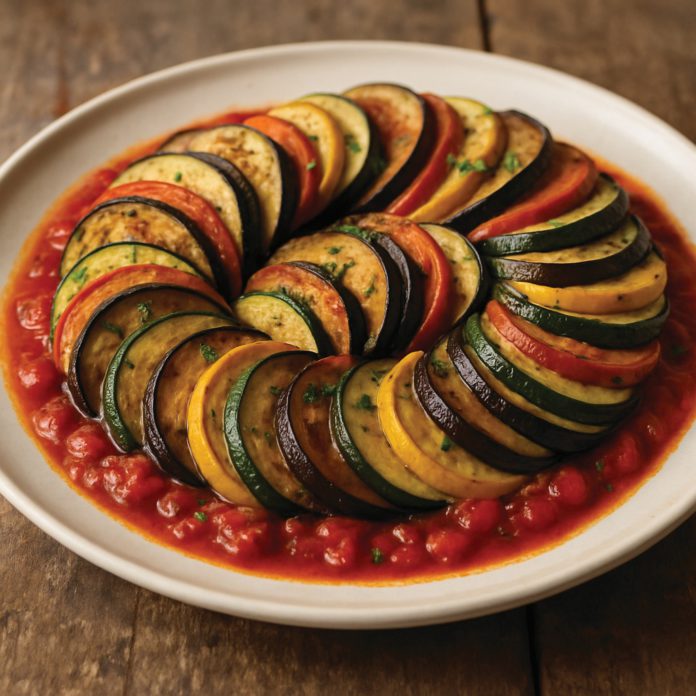
It’s finally ratatouille season. The French dish of stewy vegetables (as well as its namesake animated film) is a favorite of mine, so much that every year, I try to find someone to argue with me about it.
I often try arguing at Petaluma’s Jupiter Foods with Dan Bleakney-Formby, since he is a greengrocer and vegetable nerd. Plus, the outdoor half of his shop, that dreamy micro-farmers’ market where Jupiter proves its motto, “We know your farmer,” is usually where I realize the season has begun.
When large eggplants, bright peppers, crowding basil, fat onions and odd-shaped tomatoes flood the markets and people are almost bored of zucchini, the season is here. California gardeners know these plants suddenly overproduce in early mid-August—one has to do something, or they’ll rot, causing all that hard work or the money they gave Bleakney-Formby to go down the drain. Too many tomatoes. Too many zucchini. Almost too many bell peppers. Basil threatening to break one’s heart and collapse into black slime.
“It’s finally ratatouille season,” I say to Bleakney-Formby.
“Is it?” he replies, almost as if he has things other than ratatouille on his mind. Not me; only ratatouille-related questions occur: Should I get basil, even though I already have pesto? Do I have garlic? Is it sacrilegious to use Jimmy Nardello peppers in any stew? Could Roma tomatoes be delicious enough, if they’re from Yagi Sisters Farm? (Yes, no, sort of, yes.)
“You know what you could do, too,” Bleakney-Formby says. Oh, here it comes. “You could make a tian. It’s the same ingredients as ratatouille, but it’s like a casserole, with stacked vegetables, like in the Pixar movie.”
No, Dan Bleakney-Formby, I could not. Want to argue about why? But he’s busy, already off thinking about something other than ratatouille.
A crucial question in food is, obviously, “What is food?” Related: “Who is food for; who makes it; when, how and where?” Tian’s answers would be: Food is a professionalized endeavor, for adult strangers, made by paid people, quickly, in an organized kitchen. As for “Why?” the tian says: To impress, as much as to nourish. Ratatouille disagrees: Food is sustenance and culture, for family, especially children, made by a grownup, usually a mom, in a home kitchen.
Why? To nourish, only.
In the film, scenes of actual ratatouille show the strong magic of impressive as well as homey versions: A cook begins to prepare the dish, choosing a sprig of thyme and a traditional recipe card showing a picture of stew. She’s stopped by Remy, the chefly rat. Instead, Remy indicates a course of action which in real life was developed by chefly chef Thomas Keller. This is the tian, also known by its even fancier name, Confit Byaldi.
When restaurant critic Anton Ego eats this food, plated in the now-famous configuration of meticulously sliced and size-matched vertical and horizontal stacks of vegetables, he’s emotionally transported. He’s “taken” to his childhood home, where his mother soothingly plonks down a bowl of rough-chopped, long-simmered ratatouille.
Dan Bleakney-Formby, I still want to argue—but we might both be right.
Jupiter Foods is located at 100 Petaluma Blvd. N., Petaluma. Visit jupiterpetaluma.com.