El Infierno Cantina sits within a nondescript building on a street corner in Santa Rosa’s Railroad Square.
Through the entrance area, past the bar and a scattering of high-top tables, and up a set of stairs lies a surprisingly large venue space with a full-sized stage, sound booth and elevated booth seating wrapped around a sizable dance floor.
Formerly the location of The Last Day Saloon, El Infierno Cantina (on Santa Rosa’s 5th Street) is packed from 9pm, every Friday and Saturday, as a nightclub that specializes in high-energy Latin DJs and bands. On Sunday, July 27, though, it opened its doors to host the fifth anniversary of Nothing to Fear, a punk and metal festival put on by local promoter Down the Street Booking.
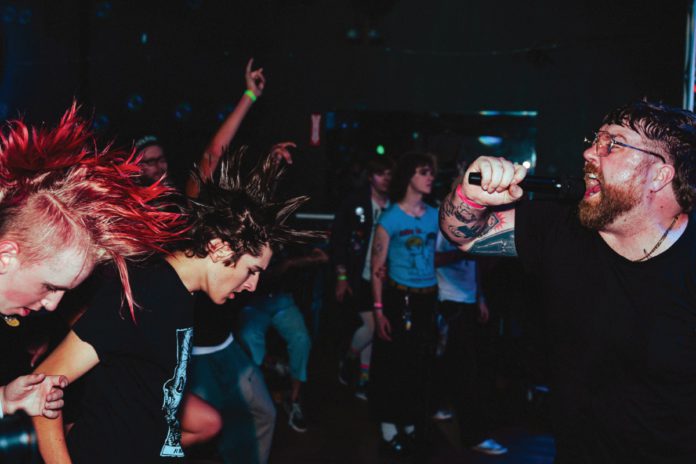
From 3 to 10pm on that Sunday, 16 bands from Sonoma County, the greater Bay Area and beyond congregated in the space to rip through 25-minute sets across three different stages, or one stage and two makeshift floor-pits, to be more precise.
Some folks in attendance came to see local favorites like New Low, a brutal post-hardcore outfit, and Sex-Ed, a freaky mishmash of electronic production and high-energy punk, but many in attendance were there for the sake of supporting the show or discovering something new. Most striking was the generational spread of the audience. Teenagers with dyed liberty spikes, grandpas wearing Asics and everyone in between were interspersed in the crowd, throwing up horns and trying not to get laid out in the pit.
It may be surprising to learn that Santa Rosa has a relatively robust scene for DIY and heavier genres of music. Running along the fringes of Americana, funk and cover shows that pop up in every winery and brewery in town is a collective of bands, fans and organizers dedicated to keeping things a little louder.
Gabriel Ferreira was born and raised in Sonoma County. In 2006, as he and his friend were walking out of a Taco Bell, something happened that changed the general trajectory of his life. “Some hipster on a bike rode up to us and gave us the tiniest little pocket-sized flyer for a show at Last Day Saloon (now El Infierno),” he says. “We went, and this band played a lobby show. That was my first introduction to the music scene in the city that I lived in.”
Years later, Ferreira now runs Down the Street Booking, a local booking platform that puts on one to two shows monthly across town. Many of the acts in Down the Street shows are local or from surrounding cities, but Ferreira will also work with out-of-town bands on tour, hoping to fill out their dates on a West Coast run.
“I do come across people occasionally who come to a show and say they had no idea we had national touring acts coming through our scene,” says Brandon McCubbin. He runs Bitter End Booking, another Sonoma County-based booking agency that focuses on heavier genres. McCubbin has recently expanded the scope of Bitter End to include band management and regional booking, and he has his eyes on building toward a national platform. But at the same time, he remains loyal to his hometown. “I will always book shows here in Sonoma County. This is my home, and I’ll never leave,” he notes.
Since right after the Covid lockdowns were lifted, Ferreira and McCubbin have been operating at full-tilt booking shows around Santa Rosa. One of Ferreira’s first shows was called Outside Bands and took place at the now closed Whiskey Tip on Sebastopol Road. He has been working with El Infierno for some time to bring in regular shows. McCubbin consistently books at the Arlene Francis Center in Railroad Square and Shady Oak Barrelhouse, and recently brought Death Metal to the California Theater in Downtown Santa Rosa for the first time.
While both acknowledge there are challenges to booking in Santa Rosa, neither complains about a lack of available talent. Here is an incomplete list of local bands worth checking out, as compiled by McCubbin in under 10 minutes: Laceration, Hexen House, Coffin Hunters, Hangnail, Deer Lord, Burning Palace, Sex-Ed, A Hero To Fall, Intrinsic Maleficence, Trecelence, Scythe. This doesn’t even include the innumerable acts from Oakland and Sacramento that he and Ferreira have working relationships with. It would appear that our city has an embarrassment of riches when it comes to music to hit something to.
The real obstacle to booking shows in Santa Rosa is two-fold. First, getting people to come to shows. “A good attended show for what I’m doing is 30 to 35 people,” says Ferreira. At this number, he explains, he can break even on his costs and pay out a bit to the bands he’s booked. “We don’t always get there, but it usually works out,” he adds.
“Santa Rosa is what is called a B-market,” says McCubbin. In booking-industry terms, that refers to the quantification of potential audience turnout and cultural interest in a specific genre of music. With a metropolitan population of roughly 175,000 people, it feels reasonable to assume that there are at least 35 people in Santa Rosa who are interested in punk and metal, but many of them may already have plans to attend a different show locally or go see a bigger act in an A-market venue in San Francisco.
The other obstacle is venues. Santa Rosa is in constant flux for available venue space, especially during peak weekend hours. One option for DIY bookers is to just hold shows at off-the-books spaces. I have been to shows in tattoo shops, taquerias and barns, but these spaces inevitably get shut down. “There aren’t many venues that are all ages and serve alcohol. Which is crucial when you need a big turnout,” says McCubbin.
“There will always be somewhere to throw a show because people want to have shows here,” says Ferreira, “but it’s hard to find something permanent.”
As a result, bookers in the area will create a patchwork of shows at various venues, which can be hard for people to track. The best bet for anyone trying to keep a finger on the pulse of DIY shows in Santa Rosa would be to follow the bookers themselves on social media.
Despite the challenges inherent to putting on this type of show in Santa Rosa, neither Ferreira nor McCubbin gives any indication of wanting to stop.
For Ferreira, there is an element of giving back inherent to what he does. “I’m a dude who plays guitar in a band first and foremost,” he clarifies, “but I really like being able to help other bands get shows when they reach out to me.” He also hopes other people in the area get inspired to start throwing their shows as well. “You don’t need to be where I am with equipment and experience to do this. You just need to have the drive and passion to do it and stick with it,” he continues.
McCubbin’s thoughts on continuing are in a similar vein: “Music is my life. I do it because I love it, and I don’t see myself ever stopping, even when it gets hard or I lose money on big touring packages.”
In terms of the future of the scene, there is only so much a handful of folks can accomplish. The truth is that supply shows up for demand. If someone wants there to be more punk in their area and say, hypothetically of course, they read an article in their local paper about two guys working hard to make that a reality, perhaps the best thing they can do is find out when and where the next show is and go to it.