There were no kings present at Bohemian Grove Saturday morning, as Donald Trump is not a member, but Mary Moore, who co-founded the protests there 45 years ago, was certainly Queen for a Day.
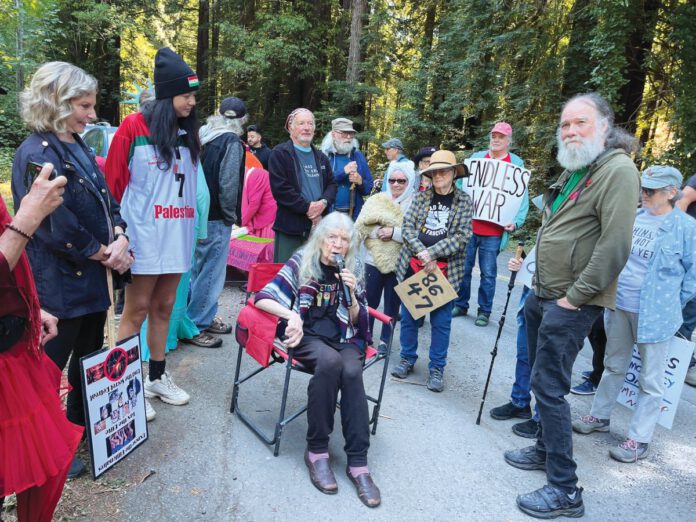
Sitting in a folding chair, Moore addressed the approximately 50 supporters who had gathered just down the road from the private Monte Rio campground. She got a big “coyote howl” for her steadfast support of bringing all the issues together at the many protests over the years, and a couple of happy birthday songs. Moore turned 91 July 14, Bastille Day.
“This is a perfect place if you’re an activist who is frustrated by single issue politics,” Moore said, naming many of the famous activists who have attended the protests in the past, including Angela Davis, Dolores Huerta and American Indian Movement founder Bill Wahpepah.
Moore and her colleagues in SONOMoreAtomics organized the first Bohemian Grove action in 1980. They had been protesting the construction of the Diablo Canyon nuclear reactor near San Luis Obispo and discovered that many who profited from the nuclear industry attended the annual two-week encampment at the Bohemian Grove. According to the U.S. Department of Energy, scientists and politicians discussed the feasibility of the first nuclear bomb, called the Manhattan Project, at the Grove.
A former employee at the Grove provided them with a membership list, which also included many prominent business and political leaders. For many years, until his death from AIDS, the employee, who they called “Deep Throat,” brought them membership lists and information about the Lakeside Talks at the encampment, which focused on both national and international issues, according to Moore.
A year later, Mother Jones magazine published an article by Rick Clogher, about the Grove and the protests, and suddenly it went from an almost secret gathering to an international story. The protest group, now calling itself the Bohemian Grove Action Network, helped Clogher sneak onto the Grove during both weekends of the encampment.
The Bohemian Club administration, however, says the encampment is actually an opportunity for like-minded men to have a good time together. It even features an opening ceremony called the cremation of care, where the men burn an effigy of “dull care” in front of a 40-foot stone statue of an owl and commit themselves to enjoying a pleasant vacation.
Unlike the large, and sometimes boisterous, protests in the 1980s and 1990s, Saturday’s event was sedate. There was no line of sheriff’s deputies holding back the crowd, only a single officer in a patrol car who drove quietly up to the Grove entrance and then back toward Monte Rio.
Instead, this protest began with a ritual called the “Resurrection of Care,” to counter the Cremation of Care, and then proceeded to a handful of speeches and a skit about protesters entering the Grove and confronting the campers. The Grove is guarded by security, and outsiders can only enter by invitation.
The protest participants Saturday were mostly gray-haired west county residents, many of whom had attended Bohemian Grove protests in the past. In her speech, Moore referred to them as “aging hippies.”
One of them, Jan Shade, said in a brief interview, “I’m here because I have a history with the Bohemian Grove protests, and I’m mighty, mighty proud of the people who have come over the years.”
Possibly the youngest participant, 45-year-old James Woodruff, pushing a small cart loaded with beverages and snacks, said, “This is different than the usual protest I go to in Santa Rosa. It’s a perfect place to protest all the inequality.”
Still, the organizing group, the newly-formed Sonoma County chapter of CODE PINK, felt the protest was worth the effort, no matter the size of the turnout.
“I think it never hurts to draw attention to the disparity of wealth,” said Robin Latham, the lead organizer.